Etsy marketing automation examples for boosting ad ROI
Discover effective Etsy marketing automation examples to enhance your ad ROI. Boost revenue and streamline your shop’s performance today!

Running paid ads for a handmade Etsy shop is demanding work. You're crafting products, managing orders, and simultaneously trying to figure out why your ad spend isn't converting into predictable revenue. The gap between clicking "boost" and seeing a real return is where most sellers get stuck, spending money without the data to know what's actually working. Automation changes this equation. This article walks through practical examples of Etsy marketing automation, from ad tracking and email flows to listing optimization and fulfillment, with real benchmarks and step-by-step strategies you can apply to your own shop.
Table of Contents
- How to choose the right Etsy marketing automation
- Ad automation: Tracking and optimizing Etsy Ads for ROI
- Email marketing automation for Etsy sellers
- AI, listing, and fulfillment automation: Real Etsy shop wins
- Summary comparison: Which automation drives the highest ROI?
- The uncomfortable truth about Etsy automation: Why more doesn't always mean better
- Enhance your Etsy automation with IndiePixel tools
- Frequently asked questions
Key Takeaways
| Point | Details | | --- | --- | | ROAS is key | Target at least 3x ROAS for Etsy Ads to grow profitably; new shops should expect lower benchmarks initially. | | Automate proven flows | Email, ad tracking, and listing automation produce the best results when focused on high-converting products and buyers. | | Data-driven scaling | Scale ads or automations only after 14-30 days of stable metrics and consistent conversions. | | Time reduction wins | AI and POD automation dramatically free up seller hours and drive sales, especially for handmade businesses. | | Quality over quantity | Effective automation starts with quality listings and flows—not just more tools or shortcuts. |
How to choose the right Etsy marketing automation
Before you automate anything, you need to know what success looks like. Two metrics matter most for Etsy ad campaigns: ROAS (return on ad spend) and conversion rate. ROAS measures how many dollars you earn for every dollar spent on ads. Conversion rate tells you what percentage of visitors actually buy.
For profitable campaigns, 3-5x ROAS benchmarks represent the standard target. New shops with limited sales history typically see 1.5-2.5x ROAS while building trust and listing data. Established shops with strong reviews and proven organic converters can hit 5x or higher when automation is applied correctly.
What you can automate on Etsy:
- Ads management: Bid adjustments, keyword pausing, budget scaling based on ROAS thresholds
- Listing optimization: AI-assisted titles, tags, and descriptions for better SEO ranking
- Email marketing: Welcome sequences, post-purchase flows, review requests, win-back campaigns
- Order fulfillment: Print-on-demand (POD) integrations that auto-fulfill without manual processing
Not every automation deserves equal priority. Use these three criteria to decide where to start:
- Impact on revenue: Will this automation directly increase sales or reduce wasted spend?
- Time saved per week: Does it free up hours you currently spend on repetitive tasks?
- Data quality improvement: Will it give you cleaner attribution data to make better decisions?
Pro Tip: Before selecting any automation tool, calculate your breakeven ROAS by factoring in your production cost, Etsy fees (6.5% transaction + listing fees), and shipping costs. If your margin is 40%, you need at least 2.5x ROAS just to break even. Tools that track your Etsy ad KPIs in real time make this calculation automatic rather than a monthly spreadsheet exercise.
Ad automation: Tracking and optimizing Etsy Ads for ROI
With your criteria established, the next step is understanding how ad automation tools actually perform in practice.
The core challenge with Etsy Ads is that the platform's native dashboard shows clicks and impressions but offers limited insight into which specific listings or keywords drive profitable orders. Automation tools fill this gap by tracking ROAS at the listing level, flagging underperformers, and surfacing keywords worth scaling.
According to proven ad optimization methodology, the framework that works consistently looks like this:
- Advertise only listings with a proven organic conversion rate of 2% or higher
- Start at $1-5 per day per listing to gather data without overspending
- Pause listings with less than 2x ROAS after 14 days of running
- Scale winning listings by increasing budget 20-30% at a time
- Conduct weekly reviews rather than daily adjustments
This methodology prevents the most common mistake: spending heavily on listings that haven't proven they can convert organically.
New shop vs. established shop: Ad performance benchmarks
| Shop Type | Expected ROAS | Recommended Daily Budget | Review Frequency | |---|---|---|---| | New (under 6 months) | 1.5-2.5x | $1-3/day per listing | Weekly | | Growing (6-18 months) | 2.5-4x | $3-7/day per listing | Weekly | | Established (18+ months) | 4-7x+ | $5-15/day per listing | Bi-weekly |
Weekly ad review workflow:
| Week | Action | Decision Trigger | |---|---|---| | 1-2 | Gather baseline data | No changes unless ROAS is under 1x | | 3-4 | Pause poor performers | ROAS below 2x after 100+ clicks | | 5-6 | Scale top performers | ROAS above 4x, increase budget 25% | | 7+ | Expand to similar listings | Use winning keywords on related products |
One real-world example stands out: a focused ad strategy produced 103% revenue growth reaching $47,848 in total revenue alongside a 104% increase in orders within just 30 days. This kind of outcome comes from disciplined automation, not from spending more. You need to track Etsy ad KPIs consistently to replicate it.

Understanding Etsy paid ads best practices is also critical before you scale. Automation amplifies what's already working, but it also amplifies what isn't. If your listings have weak photos or unclear titles, more ad spend makes the problem worse faster. Fix the foundation first, then automate the scaling. For a deeper look at tactical adjustments, Etsy ad optimization tips can guide you through the specific levers to pull at each stage.
Email marketing automation for Etsy sellers
Beyond ads, email is one of the highest-ROI channels available to Etsy sellers. The challenge is that Etsy doesn't natively support robust email marketing. You need to build your list through your website, social channels, or post-purchase opt-ins, then manage flows through a platform like Mailchimp or Klaviyo.
Email automation for Etsy sellers built around welcome series, post-purchase flows, review requests, and win-back campaigns, segmented by buyer behavior, consistently drives repeat purchases and stronger lifetime customer value.
The four core automations to set up first:
- Welcome series (Days 1, 3, and 7): Introduce your brand story, highlight bestsellers, and offer a small discount on the next purchase. This flow builds familiarity with buyers who found you through ads.
- Post-purchase flow (48-72 hours after delivery): Send a personalized thank-you, care instructions for the product, and a gentle nudge toward related items. Buyers are at peak satisfaction right after receiving a handmade item.
- Review request (5-7 days after delivery): Timing matters significantly here. Asking too early misses buyers who haven't fully experienced the product. Asking too late loses momentum.
- Win-back campaign (45-90 days after last purchase): Segment buyers who haven't returned and send a targeted offer based on what they originally bought. A candle buyer who hasn't reordered in 60 days is a strong win-back candidate.
Segmentation strategies that improve open rates and conversions:
- Segment by product category so messaging is relevant, not generic
- Separate first-time buyers from repeat customers for different messaging tones
- Use order value thresholds to identify high-value buyers worth a VIP sequence
- Filter by recency to prioritize active subscribers over dormant ones
"Segmenting by product type and recency, rather than sending the same email to your entire list, is the single most effective change sellers can make to improve email revenue per recipient." This is consistent with best practices across Klaviyo and Mailchimp data for product-based businesses.
Pro Tip: Inside your email platform, track revenue per email (total revenue divided by emails sent for each flow). This tells you which automation is worth expanding versus which one you should simplify. Most handmade sellers find that post-purchase and win-back flows generate far more revenue than broadcast campaigns. Pair this with broader Etsy marketing guides to build a complete strategy.
AI, listing, and fulfillment automation: Real Etsy shop wins
Ad and email automation handle demand capture and retention. Listing and fulfillment automation handle your product presentation and operations. Together, they create a system where more sales don't automatically mean more hours worked.
AI-assisted listing tools like Marmalead and eRank analyze search volume, competition, and trending keywords to help you write titles and tags that rank better organically. Better organic ranking means lower cost-per-click when you do run ads because your quality score improves. It also means more free traffic, which gives you the conversion data you need before spending on ads.
One real case makes the impact clear: an Etsy shop doubled monthly sales from $2,300 to $4,750 by using AI for listing optimization, SEO tools, automated customer responses, and social scheduling, while reducing work hours from 50+ per week down to 30. That's both a revenue improvement and a quality of life improvement at the same time.
How AI-driven listing automation improves performance:
- Stronger keyword matching in titles and tags improves search ranking without extra ad spend
- Automated customer response templates reduce response time, which improves seller metrics
- Social content scheduling (Pinterest, Instagram) drives consistent traffic without daily manual effort
- A/B testing tools identify which thumbnail photos perform best before you commit to ad spend on a listing
For order fulfillment, POD automation through Printify auto-fulfills orders as they come in, completely eliminating manual packing and shipping for print-based products. Sellers who integrate POD report that the freed time gets reinvested into Etsy Ads management, Pinterest strategy, and TikTok content, which generates more sales without adding work hours. Personalization options like custom names or dates can be added without manual handling, which increases average order value (AOV).
Impact of automation across key shop metrics:
| Automation Type | Sales Impact | AOV Change | Hours Saved/Week | Customer Satisfaction | |---|---|---|---|---| | AI listing optimization | +35-50% organic traffic | +8-12% | 3-5 hours | Higher (better product fit) | | Email automation | +20-30% repeat purchases | +15% | 4-6 hours | Higher (timely communication) | | POD fulfillment | Scales with orders | +10-20% (personalization) | 8-15 hours | Higher (faster delivery) | | Ad tracking automation | +40-60% ROAS efficiency | Neutral | 3-4 hours | Neutral |
Pro Tip: Never run ads on a listing that doesn't have organic traction yet. Use ecommerce analytics to confirm at least a 1.5-2% organic conversion rate before adding any ad budget. If a listing can't convert free traffic, paid traffic will only drain your budget faster. The 30-day ad strategy playbook outlines exactly when to introduce ad spend after organic validation.
Summary comparison: Which automation drives the highest ROI?
With all four automation categories reviewed, here's a direct comparison to help you decide where to invest first based on your shop's current stage.
Automation ROI comparison for Etsy sellers:
| Automation Type | Setup Difficulty | Time to See ROI | Best For | Long-Term Impact | |---|---|---|---|---| | Ad tracking and optimization | Medium | 2-4 weeks | Shops spending $10+/day | Very high | | Email marketing flows | Medium | 4-6 weeks | Shops with repeat buyers | High | | AI listing optimization | Low | 4-8 weeks | All sellers | High | | POD fulfillment | Low-Medium | Immediate | Print-based products | Very high | | Social media scheduling | Low | 6-12 weeks | Shops with visual products | Medium |
Situational recommendations for handmade sellers:
| Your Situation | Start Here | Then Add | |---|---|---| | New shop, under $500/month revenue | AI listing optimization | Email welcome series | | Growing shop, $500-$2,000/month | Email automation flows | Ad optimization tools | | Established shop, $2,000+/month | Ad tracking and scaling | POD or fulfillment automation | | Running external ads (Facebook/TikTok) | Conversion tracking tools | Full email segmentation |
The 103% revenue growth case study and the shop that reached $2.8 million in all-time revenue both followed a similar pattern: strong listings first, then systematic ad scaling, then email automation layered on top. Sellers who try to run all automations simultaneously often create data noise that makes attribution harder. For sellers tracking Etsy ad conversions from external platforms, layering automation in sequence is especially important to maintain clean data.
The uncomfortable truth about Etsy automation: Why more doesn't always mean better
Here's what the case studies don't always show clearly: automation rewards patience, not speed. Most sellers who struggle with Etsy Ads aren't failing because they lack tools. They're failing because they're making changes before the data is stable.
The edge case reality is this: new shops achieve lower ROAS of 1.5-2.5x due to limited data, and listings with fundamental problems produce ROAS under 1.5x regardless of how much automation you layer on top. No automation tool fixes a listing with poor photos, a confusing title, or a price that doesn't match buyer expectations.
The sellers who consistently win automate only what's already proven. They advertise listings with demonstrated organic conversion rates. They wait at least 14 days and 100 clicks before drawing conclusions about any campaign. They understand their true break-even ad math down to the cent and won't scale until they're consistently above it.
The "automate everything immediately" approach creates a different kind of problem. When you run ads, email flows, listing tests, and POD integration all at once from day one, you can't isolate what's actually driving results. You can't tell if more sales came from better listings or from the email win-back campaign. Clean attribution requires a sequenced approach.
The practical framework worth following: fix listings first, confirm organic conversions at 2%+, then add ad spend. Layer in email automation once you have at least 50 past buyers to segment. Add fulfillment automation when order volume makes manual processing a bottleneck, not before. For tactical specifics on timing, the Etsy ad optimization insights section covers the exact signals to watch before escalating spend.
The sellers who reach $2,000+ per month and beyond aren't the ones running the most automations. They're the ones running the right automations on the right listings at the right time.
Enhance your Etsy automation with IndiePixel tools
The strategies in this article work best when you have clean, reliable data connecting your ad spend to actual Etsy purchases. That's exactly the gap IndiePixel is built to close.
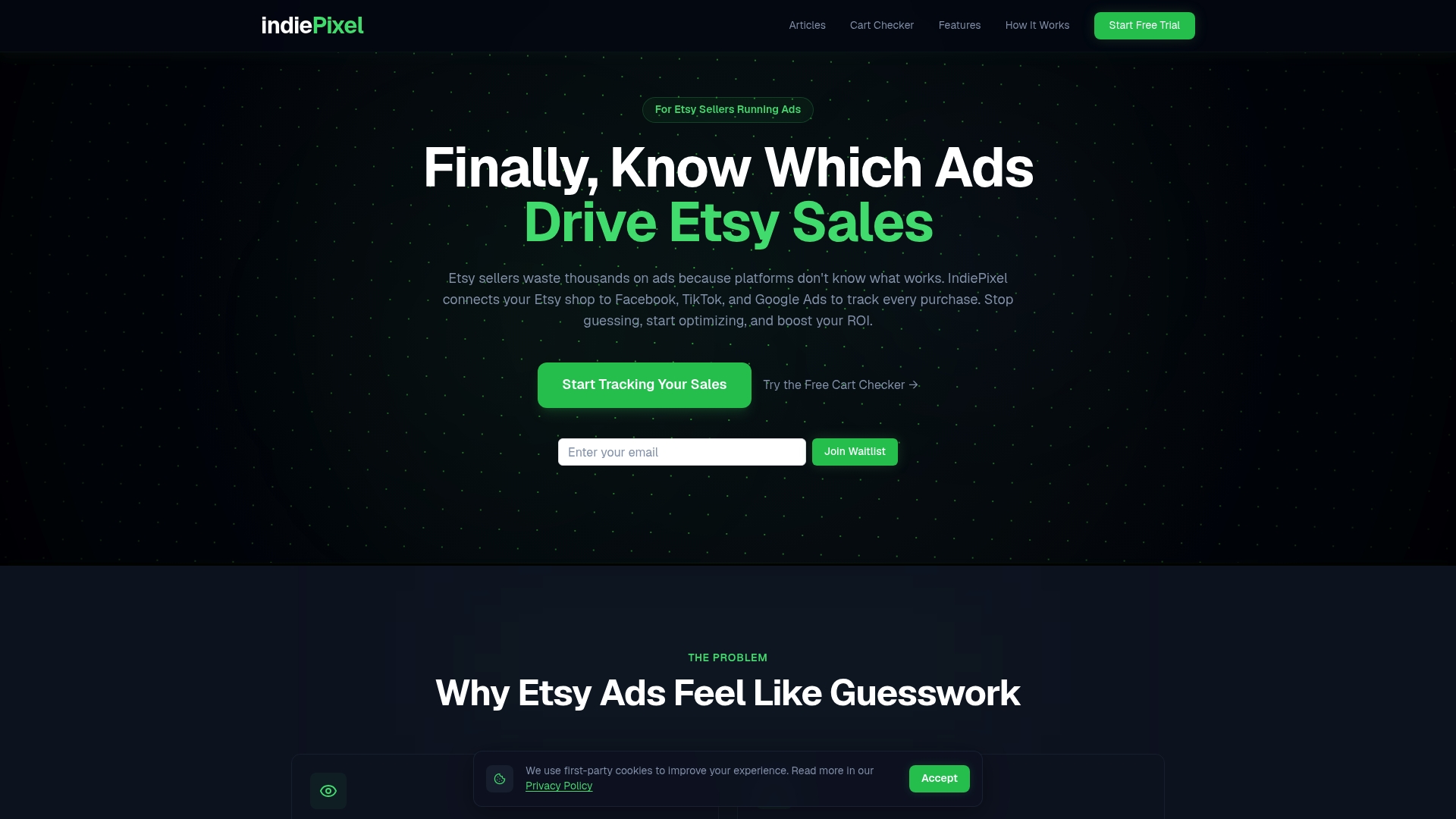
IndiePixel bridges the tracking gap between external ad platforms like Facebook, TikTok, and Google Ads and your Etsy shop, giving you purchase-level attribution data that Etsy's native dashboard simply doesn't provide. With the platform's conversion API sync, unified dashboard, and cart checker tool for pre-spend validation, you can confirm which campaigns are actually driving sales before you scale. If you're ready to remove the guesswork from your ad optimization and run your automation stack on real data, explore IndiePixel's Etsy ad tracking tools to see how attribution tracking fits into your setup.
Frequently asked questions
What is a good ROAS benchmark for Etsy Ads?
Profitable Etsy Ads typically require a 3-5x ROAS as a baseline target, though new shops with limited conversion data often see 1.5-2.5x while building listing history. Always calculate your specific breakeven ROAS based on margins and fees before using any benchmark as a scaling trigger.
Which automations should I prioritize as a handmade Etsy seller?
Start with AI listing optimization and a basic email welcome flow, then introduce ad spend only after organic conversion rates reach 2% or higher. Fulfillment automation like POD makes sense once manual order processing is eating significant time each week.
How can I reduce manual work while improving ad ROI?
AI listing tools, segmented email automation, and POD fulfillment together can cut weekly work hours significantly, as one documented case shows a drop from 50+ hours to 30 while doubling monthly sales. Prioritize automations that both save time and generate conversion data you can act on.
When should I scale or pause my Etsy ad spend?
Follow the 14-day, 100-click rule: pause listings below 2x ROAS after that threshold and scale winners 20-30% at a time. Avoid making budget decisions before you have statistically meaningful data.
Can automation tools help with tracking external ad traffic to Etsy?
Yes. Dedicated tools can capture purchase signals from Facebook, TikTok, and Google Ads campaigns and send that conversion data back to the ad platforms, giving you accurate attribution that Etsy's native tools don't support natively.