Top Etsy ad optimization tips to maximize your ROI
Unlock your sales potential with these expert ad optimization tips for Etsy. Learn to maximize your ROI and boost your profits today!

Etsy ads can be a powerful growth lever, but too many sellers burn through their budgets without seeing meaningful returns. The difference between wasting money and generating real profit often comes down to a few disciplined, data-driven decisions: choosing the right listings, setting realistic budgets, monitoring the right metrics, and knowing when to let the algorithm do its job. This article walks you through a practical, step-by-step approach to optimizing your Etsy ad campaigns so every dollar you spend has a clear purpose and a measurable result.
Table of Contents
- Set smart budgets and focus your spend
- Let Etsy's algorithm optimize: Give ads time to learn
- Track and analyze your data for smarter decisions
- Compare ad vs. organic strategies for lasting success
- Our perspective: What most Etsy sellers miss about ad optimization
- Tools for data-driven Etsy ad optimization
- Frequently asked questions
Key Takeaways
| Point | Details | | --- | --- | | Set realistic ad budgets | Smart budget limits let sellers collect data without risking excessive losses. | | Trust the algorithm’s learning period | Allow at least 30 days for Etsy’s system to optimize and yield reliable results. | | Track key performance metrics | Monitor click-through rates, conversions, and ROI to guide smarter campaign decisions. | | Balance ads with organic SEO | Combine paid and organic approaches for sustainable marketplace growth. | | Use advanced tracking tools | Leverage powerful analytics solutions to maximize your Etsy ad ROI. |
Set smart budgets and focus your spend
Now that you've committed to boosting your Etsy ad ROI, let's start with the foundation: your budget and listing focus.

Most sellers make one of two mistakes early on. They either spread their budget across every listing in their shop, diluting performance data to the point where nothing is statistically meaningful. Or they set a budget so high it burns out before they've collected enough information to make intelligent adjustments. Both approaches produce the same outcome: wasted money and unclear results.
The most reliable starting point, according to Etsy's own guidance, is to start with $1-5 per listing or $5-10 total daily across a focused set of 3 to 10 listings. This keeps your spend controlled while still generating enough impression and click data over a 30-day window to make informed decisions. Running too many listings at once fragments your data and makes it nearly impossible to isolate what's working.
Selecting the right listings to advertise is just as important as the budget itself. You want to promote listings that already show signs of organic traction, not ones you're hoping ads will rescue.
Here's how to identify your top-performing listings before you assign ad spend:
- Check your shop stats for listings with the highest organic views and favorites over the past 90 days.
- Review your conversion rate for each listing. A listing converting at 2-4% organically is a strong candidate. A listing with zero sales history is a risk.
- Look at your reviews and note which products have the most positive feedback. Social proof amplifies ad performance.
- Identify seasonal relevance. Promoting a Halloween item in February will drain your budget with minimal return, no matter how optimized your listing is.
- Check price margins. Products with thin margins require a lower cost-per-click threshold to stay profitable. Factor in production, shipping, and Etsy fees before deciding.
You can explore proven ad strategies to understand which listing attributes tend to perform best under paid placement.
Pro Tip: Use your shop's conversion rate data to rank listings before enabling ads. A listing with strong organic conversion is far more likely to generate a positive return on ad spend. Our conversion rate guide breaks down exactly what benchmarks to target by product category.
Once you've selected your listings and set your daily budget, resist the urge to keep adjusting it week to week. Consistency during the early phase gives the algorithm room to work, which brings us to the next critical step.
Let Etsy's algorithm optimize: Give ads time to learn
After setting your budgets and picking listings, your next step is to trust Etsy's ad system to work, but only with the right duration and monitoring.
Etsy's ad algorithm is not static. It actively learns which buyers are most likely to click and convert based on signals like click-through rate (CTR), actual conversions, and dwell time (how long a shopper stays on your listing after clicking). These three factors combine to form what Etsy calls a quality score, and that score directly influences how competitively your ads are placed in the auction. Understanding ad placement mechanics helps you appreciate why patience during this phase is not passive, it's strategic.
According to Etsy's seller handbook, you should run ads for at least 30 days before making major changes. The algorithm needs this window to optimize bids, learn audience behavior, and test different placements. Cutting campaigns short or constantly adjusting bids resets this learning process and leaves you with incomplete data.
Here's a simple monitoring process to follow while your ads are learning:
- Log your starting metrics on day one: impressions, clicks, CTR, and any orders generated.
- Check stats weekly, not daily. Daily fluctuations are normal and can mislead you into premature changes.
- Flag listings with zero clicks after the first two weeks. These may need listing improvements rather than budget adjustments.
- Compare CTR by listing. A CTR below 0.5% over 14 days suggests the listing thumbnail or title may not be compelling enough to attract clicks.
- Track conversions relative to ad spend at the 30-day mark. This is your first real signal about profitability.
"Sellers who make significant changes to their ads within the first two weeks are essentially restarting the learning process. Giving the algorithm 30 full days produces far more reliable optimization signals than constant manual intervention." — IndiePixel
Review your listing optimization tips if you find that clicks aren't converting. Sometimes the issue isn't the ad placement itself, it's what happens after the click. Weak photos, unclear descriptions, or inconsistent pricing relative to market expectations all suppress conversions even when ad delivery is strong.
Track and analyze your data for smarter decisions
With your ads running and the algorithm working, the real improvements come from interpreting your results and optimizing further.
Tracking your Etsy ad performance accurately is what separates sellers who grow profitably from those who simply spend. Etsy's native reporting gives you access to impressions, clicks, revenue, and ad spend by listing. But this data only tells part of the story, especially when you're also running off-platform campaigns on Facebook, TikTok, or Google.
Here's what a basic performance snapshot might look like for three advertised listings:
| Listing | Ad spend | Revenue | ROAS | Conversions | Action | |---|---|---|---|---|---| | Custom mug A | $42 | $168 | 4.0x | 8 | Scale | | Personalized print B | $38 | $57 | 1.5x | 3 | Pause or test | | Tote bag C | $25 | $100 | 4.0x | 5 | Scale |
ROAS stands for return on ad spend, calculated as revenue divided by ad spend. A ROAS analysis helps you identify your break-even threshold. For most Etsy sellers, a ROAS of 3x to 5x is achievable on proven listings. Anything below your break-even ROAS means you're losing money on ads even when you appear to be making sales.
Tools and resources that strengthen your tracking:
- Etsy's Stats dashboard: Provides listing-level data on views, visits, and revenue attributed to ads.
- Etsy's order manager: Lets you cross-reference which orders came through promoted placements.
- IndiePixel's attribution tools: Capture purchase signals and send conversion data back to platforms like Facebook and Google, giving you visibility that Etsy alone cannot provide.
- UTM parameters in off-platform links: Track which external campaigns are driving traffic to your Etsy shop, useful when running Google or social ads simultaneously.
- CSV order exports: Download and reconcile Etsy order data against ad platform spend for manual attribution analysis.
Pro Tip: Don't rely solely on Etsy's built-in reporting if you're running off-platform ads. Etsy cannot track buyers who come from Facebook or TikTok and purchase without returning through your tracked link. Combining Etsy's data with external analytics gives you a far more accurate picture of true campaign performance. Check out advanced ad strategies to see how sellers layer multiple data sources for more reliable decisions.
According to Etsy's advertising resource, ads are particularly effective at amplifying and scaling listings that are already proven, with 3-5x ROAS possible when the underlying listing is strong. This is an important qualifier: ads accelerate what's already working, but they rarely fix what's broken.
Compare ad vs. organic strategies for lasting success
You've seen how to track ad performance, but lasting marketplace growth requires deciding when paid ads or organic optimization are right for your shop.
Ads and organic SEO are not competing strategies. They serve different purposes and operate on different timelines. Understanding when to lean on each is what allows you to build a shop that grows sustainably while also capitalizing on near-term opportunities.
| Factor | Etsy ads | Organic SEO | |---|---|---| | Speed of results | Days to weeks | Weeks to months | | Cost | Ongoing spend required | Time investment upfront | | Compounding value | Low (stops when budget stops) | High (improves over time) | | Control | High (budget, listing selection) | Moderate (dependent on algorithm) | | Best use case | Launch, seasonal push, scaling | Long-term traffic and visibility | | ROAS potential | 3-5x on proven listings | Not directly measurable |
When ads make sense:
- You're launching a new listing and need early sales data to signal relevance to Etsy's search algorithm.
- You have a seasonal product with a short window of demand.
- You have a proven listing with strong conversion and want to scale it faster.
- You're testing price points or new product variations and need controlled traffic.
When organic SEO is the better investment, per Etsy's own analysis, is when you want compounding traffic without ongoing spend. Organic optimization builds equity. Every improvement to your title, tags, and attributes continues generating impressions long after the work is done.
Ways to synergize both for maximum ROI:
- Use ads to drive early sales on new listings, then let those sales history and reviews power organic rankings.
- Identify top-performing organic listings and promote them with ads to amplify already-proven results.
- Test different titles and thumbnail images using ad traffic, then apply winners to organic listings shop-wide.
- Review your SEO and ads interplay to align your keyword strategy across both channels.
- Pull back ad spend on listings once they've achieved strong organic positions to reduce cost without losing visibility.
The sellers who consistently achieve strong ROI are those who treat ads as a tool for acceleration rather than a substitute for strong fundamentals. Organic visibility and well-optimized listings are the foundation. Ads are the amplifier.
Our perspective: What most Etsy sellers miss about ad optimization
Having weighed ad versus organic strategies, let's take a candid look at optimization wisdom most sellers overlook.
Here's something we see repeatedly: sellers make decisions based on too little data, too early. A listing gets 50 clicks and no sales in the first 10 days, and the seller pauses it. But 50 clicks is nowhere near statistically significant for most product categories. Conversion rates on Etsy typically range from 1% to 5%, which means you'd need at least 100-200 clicks before drawing any meaningful conclusion. Acting on small samples produces noisy, unreliable decisions.
The other pattern we notice is sellers fixating on vanity metrics. High impressions feel encouraging. A strong CTR seems like a win. But neither of these metrics puts money in your pocket. The only metric that ultimately matters is profitable conversions, and that requires tracking what happens after the click, not just at the point of the click.
Many sellers also scale ads on listings with strong CTR but weak conversion. This is a costly error. A listing with a 3% CTR and a 0.5% conversion rate is not a good candidate for increased spend, regardless of how impressive the click volume looks. You're paying for interest, not purchases.
"Disciplined experimentation means running changes one at a time, over a full 30-day window, and measuring the outcome before making the next adjustment. Sellers who change budgets, listings, and bids simultaneously can never isolate which change produced which result." — IndiePixel
We also recommend following a practical 30-day playbook that structures your optimization decisions into defined review windows. This removes the temptation to react to short-term noise and builds a more reliable feedback loop for ongoing improvement.
The sellers who outperform on Etsy ads are not necessarily the ones with the biggest budgets. They're the ones who are most disciplined about what they measure, how long they wait, and which signals they act on.
Tools for data-driven Etsy ad optimization
Ready to go beyond manual optimization? Here's how IndiePixel helps streamline your Etsy ad decisions.
If you've been making ad decisions based solely on Etsy's native reporting, you're likely missing a significant portion of your conversion data. Etsy's built-in tools don't connect purchase events back to off-platform ad campaigns, which means you could be undervaluing Facebook, TikTok, or Google campaigns that are genuinely driving sales.
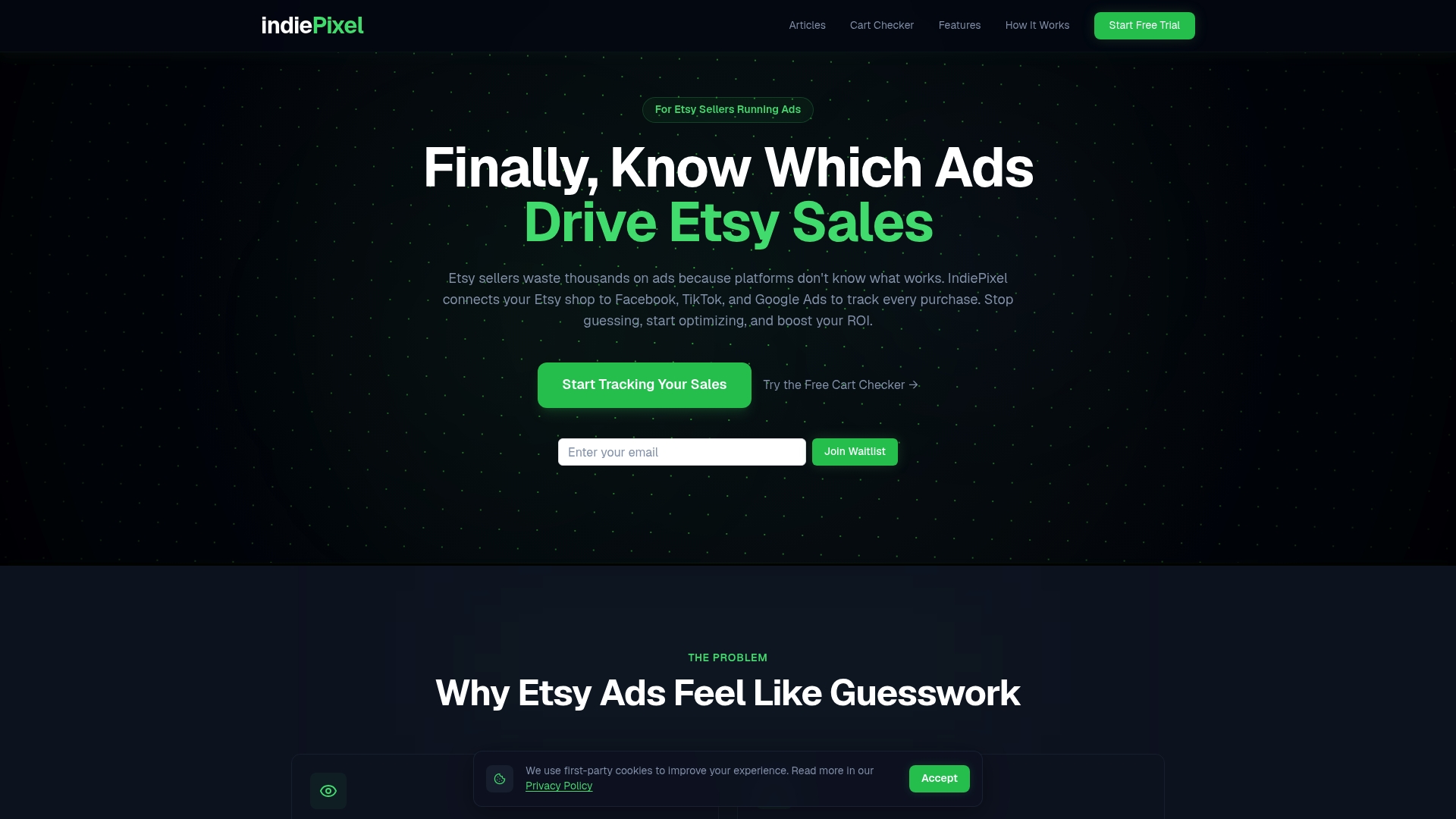
IndiePixel's ad tracking tools bridge that gap by capturing purchase signals directly from your Etsy shop and syncing conversion data back to your ad platforms through conversion API integration. This gives you accurate attribution across all your active campaigns, not just Etsy-internal placements. You can also use the cart checker tool to validate conversion activity before committing additional budget, ensuring you're scaling campaigns that are genuinely performing rather than ones that only look good on the surface. IndiePixel's unified dashboard brings all your campaign data into one place, so you spend less time reconciling reports and more time acting on clear, actionable insights.
Frequently asked questions
What is the ideal daily ad budget for Etsy sellers?
A daily budget of $1-5 per listing or $5-10 total is recommended to gather meaningful data without overspending, especially when starting out.
How long should I run ads before changing them?
Let ads run for at least 30 days to allow Etsy's algorithm to fully optimize bids, learn audience behavior, and test placements based on real performance signals.
Which metrics matter most for Etsy ad performance?
Focus on click-through rate, conversion rate, and dwell time. Etsy's quality score factors in all three to determine how competitively your ads are placed.
Is organic SEO more effective than Etsy ads?
Ads can amplify proven listings quickly with 3-5x ROAS possible, but organic SEO builds compounding traffic over time without requiring ongoing spend, making it the stronger long-term investment.