Ecommerce analytics: Boost your Etsy ad ROI with data
Learn how ecommerce analytics helps Etsy sellers track ad performance, cut wasted spend, and improve ROI with data-driven campaign decisions.

Spending money on Etsy ads without knowing what's working is one of the most common frustrations sellers face. You increase your budget, wait for results, and still can't tell which campaigns actually drove sales. Ecommerce analytics changes that. It gives you a clear view of what's performing, what's wasting your budget, and where to focus next. This guide covers the core concepts, the metrics that matter most, the tools available to you, and the practical steps to start making data-driven decisions that improve your return on every dollar you spend.
Table of Contents
- Understanding ecommerce analytics: The key to digital growth
- Core metrics every Etsy seller should track
- How to capture and analyze your Etsy ad data
- Turning analytics insights into better campaign performance
- Common pitfalls to avoid with ecommerce analytics
- What most Etsy ad sellers get wrong about analytics
- Ready to level up your Etsy ad analytics?
- Frequently asked questions
Key Takeaways
| Point | Details | | --- | --- | | Data drives results | Using analytics helps Etsy sellers understand which ads and products perform best so they maximize every dollar spent. | | Track the right metrics | Focusing on conversion rates, clicks, and ROAS gives a clear path for smarter ad investment. | | Apply insights often | Regularly reviewing analytics and adjusting campaigns leads to better, faster growth. | | Avoid common mistakes | Don’t rely on vanity metrics or ignore trends; learn from your data to stay ahead. | | Tools make it easier | Dedicated analytics solutions simplify campaign tracking and reveal new opportunities for Etsy sellers. |
Understanding ecommerce analytics: The key to digital growth
Ecommerce analytics means collecting and analyzing data from your online store and advertising channels to understand what's driving results. It's not just about counting sales. It's about connecting the dots between a shopper's first click and their final purchase.
Ecommerce analytics empowers businesses to track, measure, and optimize online sales and marketing performance, giving sellers the visibility they need to grow with confidence.
For Etsy sellers running paid campaigns, this visibility is critical. Without it, you're making budget decisions based on instinct rather than evidence. Analytics tells you which listings attract clicks, which ones convert, and which ad campaigns are actually worth scaling.
Why ecommerce analytics matters becomes clear when you realize how much guesswork costs you. A campaign that looks active because it generates clicks may be delivering zero sales. A listing with fewer impressions might be converting at a much higher rate. Only data reveals the difference.
Here's what ecommerce analytics typically covers for Etsy sellers:
- Shopper behavior: How visitors find your listings, what they click on, and where they drop off
- Sales performance: Which products sell, at what price, and how often
- Ad attribution: Which campaigns, keywords, or placements led to actual purchases
- Traffic sources: Whether buyers came from Etsy search, paid ads, or external channels
- Listing-level data: Which individual products are pulling their weight and which are dragging down your average
Tracking essential Etsy ad KPIs is where this understanding becomes actionable. When you know your click-through rate, conversion rate, and average order value, you can make precise adjustments instead of broad guesses. That precision is what separates sellers who scale profitably from those who keep pouring money into campaigns that don't deliver.
Now that you see why analytics matter, let's break down what actually makes up ecommerce analytics for Etsy sellers.
Core metrics every Etsy seller should track
Understanding which numbers to watch is the foundation of smart ad management. Not every metric deserves equal attention, and focusing on the wrong ones leads to poor decisions.
The most important ecommerce metrics for Etsy paid campaigns include:
- Impressions: How many times your ad was shown
- Clicks: How many people clicked through to your listing
- Click-through rate (CTR): The percentage of impressions that resulted in a click
- Conversion rate: The percentage of clicks that resulted in a purchase
- Cost per click (CPC): What you pay each time someone clicks your ad
- Average order value (AOV): The average dollar amount per transaction
- Return on ad spend (ROAS): Revenue generated for every dollar spent on ads
Here's how each metric connects to your profitability:
| Metric | What it tells you | Why it matters | |---|---|---| | CTR | Ad relevance and creative quality | Low CTR means your ad isn't compelling | | Conversion rate | Listing quality and buyer intent | The make-or-break number for ad ROI | | CPC | Auction competitiveness | High CPC eats into your margins | | AOV | Revenue potential per buyer | Higher AOV justifies higher ad spend | | ROAS | Overall campaign efficiency | Tells you if your ads are profitable |
KPIs like conversion rate, cost per click, and return on ad spend help guide smarter decisions and stop you from scaling campaigns that look busy but aren't profitable.
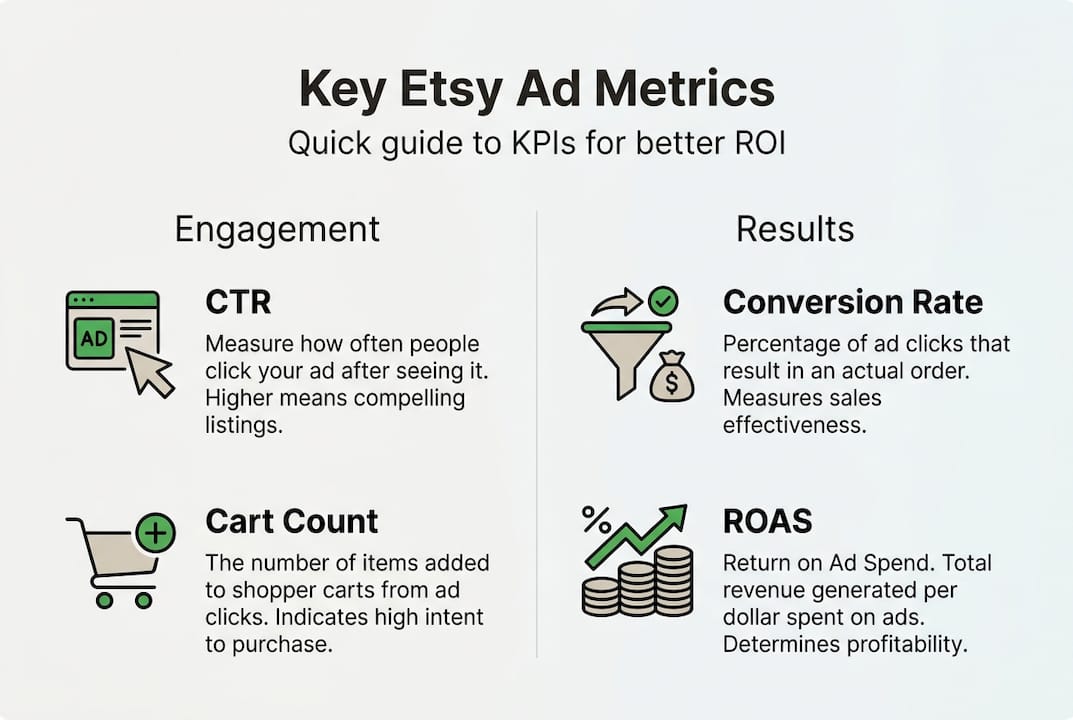
Conversion rate deserves special attention. A listing with a high CTR but a low conversion rate signals a disconnect between your ad and your listing. Maybe the photos don't match expectations, or the price feels off. Fixing that gap has a direct impact on your cost efficiency.
For improving Etsy conversion rates, start by auditing listings that receive clicks but few purchases. Small changes to photos, pricing, or descriptions often produce measurable results.

Pro Tip: Before increasing your ad budget on any listing, check its cart count. Listings with high cart counts and strong conversion rates are your safest bet for scaling spend without wasting money.
Understanding the core metrics is just the start. Next, let's look at practical tools and methods for tracking them.
How to capture and analyze your Etsy ad data
Knowing which metrics matter is one thing. Actually capturing that data is another. Etsy sellers have several options, ranging from native tools to more advanced third-party platforms.
Here's a step-by-step approach to getting your data in order:
- Open Etsy Shop Stats. Etsy Shop Stats gives you a baseline view of traffic, revenue, and listing performance directly inside your seller dashboard.
- Export your order data. Download your order history as a CSV file from Etsy's order management section. This gives you raw data you can sort and filter.
- Upload orders to an analytics platform. Platforms built for marketplace sellers let you cross-reference order data with ad spend to calculate true ROAS and attribution.
- Connect your ad channels. Link your Facebook, Google, or TikTok ad accounts to see campaign-level performance alongside your Etsy sales data.
- Set a review cadence. Check your numbers weekly at minimum. Daily monitoring during active campaigns helps you catch problems before they drain your budget.
Analytics platforms built for marketplaces offer deeper multi-channel insight than built-in Etsy dashboards, especially when you're running ads across multiple platforms simultaneously.
For Etsy order data analysis, uploading your CSV gives you the ability to segment by product, date range, or traffic source. That segmentation reveals patterns that the native dashboard simply doesn't surface.
Another underused resource is using cart count data to identify which products buyers are actively considering. High cart counts signal strong purchase intent, making those listings prime candidates for ad investment.
Pro Tip: Set up a weekly reporting routine where you review CTR, conversion rate, and ROAS for every active campaign. Spotting a downward trend early lets you adjust before you've wasted significant budget.
Once you're seeing the numbers, the real magic happens: translating data into better ads and more sales.
Turning analytics insights into better campaign performance
Data only has value when you act on it. Here's how to take what your analytics tells you and turn it into concrete improvements.
Applying insights from analytics enables sellers to optimize bids, keywords, and creative for stronger marketplace performance. That means regularly reviewing which search terms trigger your ads and cutting the ones that generate clicks without conversions.
Actionable ways to improve ad performance using your analytics:
- Pause low-ROAS campaigns rather than reducing budgets incrementally. If a campaign isn't profitable, stop it and reallocate.
- Increase bids on high-converting listings to capture more impressions where your conversion rate justifies the spend.
- Review search term reports to find irrelevant queries driving clicks. Exclude those terms to lower your CPC.
- Test different listing photos for the same product and compare CTR across variants.
- Segment by device to see if mobile or desktop buyers convert at different rates and adjust accordingly.
Here's a comparison of two common ad strategies:
| Strategy | Approach | Best for | |---|---|---| | Broad keyword targeting | Wide reach, higher impressions | New listings needing visibility | | Narrow keyword targeting | Precise reach, lower CPC | Proven listings with strong conversion rates |
Optimizing Etsy ads with search terms is one of the highest-impact actions you can take. Sellers who regularly audit their search term reports consistently report lower CPC and higher order volume over time.
Understanding how Etsy ad placement works in the auction system also gives you a competitive edge. Etsy factors in both your bid and your listing quality score. A well-optimized listing with a moderate bid can outperform a high-bid listing with weak engagement signals.
After applying these tactics, you'll be positioned to surpass your competition and avoid common data mistakes.
Common pitfalls to avoid with ecommerce analytics
Even sellers who use analytics regularly fall into patterns that limit their results. Knowing what to avoid is just as important as knowing what to do.
Frequent mistakes include ignoring outliers, relying solely on last-click attribution, and failing to test new strategies. Each of these errors can quietly drain your budget while making your campaigns look healthier than they are.
Common pitfalls and how to fix them:
- Tracking only vanity metrics. Impressions and clicks feel good but don't tell you if you're making money. Always tie metrics back to revenue.
- Ignoring channel segmentation. Lumping Facebook, Google, and Etsy traffic together hides which source is actually driving purchases.
- Misreading correlation as causation. A spike in sales during a campaign doesn't automatically mean the campaign caused it. Check for seasonal trends or external factors.
- Set-and-forget budgets. Leaving campaigns running without review wastes money on ads that have stopped performing.
- Relying on incomplete data. If your tracking setup doesn't capture all purchase events, your ROAS calculations will be wrong, and your decisions will follow.
For detailed analytics guides that go beyond surface-level advice, look for resources that address attribution gaps specific to marketplace sellers. Etsy's native tracking has real limitations, and understanding those gaps is essential.
Also, common analytics mistakes often stem from not having a consistent review process. Without a schedule, it's easy to let weeks pass without acting on the data you have.
Pro Tip: Schedule a monthly review of all core KPIs, not just sales totals. Include CTR, conversion rate, CPC, and ROAS for every active campaign. This habit catches slow declines before they become expensive problems.
With a solid understanding of the dos and don'ts, let's look at what most guides overlook and how to truly get ahead.
What most Etsy ad sellers get wrong about analytics
Most sellers treat analytics as a setup task. They connect a tool, glance at the dashboard occasionally, and assume the data is doing the work for them. It isn't.
The sellers who consistently outperform their competition treat analytics as an ongoing feedback loop. Every unexpected data point is a signal worth investigating. A sudden drop in CTR might mean a competitor launched a stronger listing. An uptick in AOV might reveal a customer segment worth targeting more aggressively.
Unlocking Etsy analytics isn't about mastering a dashboard. It's about building the habit of asking better questions. Why did this campaign underperform this week? What changed? What can we test next?
The sellers who win long-term stay curious. They iterate constantly, treat every data anomaly as a learning opportunity, and use their analytics not just to measure results but to generate new ideas. That creative, experimental mindset is what separates good sellers from great ones.
Ready to level up your Etsy ad analytics?
If you're serious about improving your ad ROI, the right tools make a significant difference. IndiePixel is built specifically for Etsy sellers who want to move beyond guesswork and start making decisions backed by real purchase data.

With IndiePixel's Etsy ad tracking tools, you can track conversions across Facebook, TikTok, and Google Ads, and see exactly which campaigns are driving sales. Use the cart count checker to identify listings with the highest buyer intent before you commit ad spend. Stop funding campaigns that look active but aren't profitable, and start scaling the ones that actually work.
Frequently asked questions
What is ecommerce analytics in simple terms?
Ecommerce analytics means using data to understand and improve how your online shop performs, especially your ads and sales. As BigCommerce explains, it empowers businesses to track, measure, and optimize online sales and marketing performance.
Which metrics are most important for Etsy ads?
The most important metrics are click-through rate, conversion rate, cost per click, and return on ad spend. These KPIs guide smarter budget decisions and reveal which campaigns are actually profitable.
How can I track my Etsy ad performance more effectively?
Use Etsy Shop Stats for a baseline, but upload your order data or use third-party analytics for deeper insight. Analytics platforms built for marketplaces surface multi-channel patterns that native dashboards miss.
What are common mistakes sellers make with ecommerce analytics?
Sellers often focus on vanity metrics like impressions and ignore conversion data, or they fail to act on the insights they already have. Frequent mistakes also include relying on last-click attribution and never testing new strategies.
How quickly can data-driven changes improve ad results?
You can often see improved performance within a few weeks by adjusting bids, keywords, and targeting based on your analytics. Applying these insights consistently leads to lower CPC and stronger overall campaign performance over time.
Recommended
- Essential KPIs for Etsy Ads: Boost ROI With Smarter Tracking
- Articles & Guides | IndiePixel
- IndiePixel | Etsy Ad Tracking for Facebook, TikTok, and Google Ads
- Etsy SEO for Sellers Running Ads: Titles, Tags, and Attributes
- 7 Must-Have Ecommerce Analytics Tools List for Mid-Market Success - BizDev Strategy
- Analytics in digital marketing: boost ROI by 29% in 2026