Essential KPIs for Etsy Ads: Boost ROI With Smarter Tracking
Learn which KPIs matter most for Etsy ads, including CTR, conversion rate, CPC, and ROAS benchmarks, and how to use them to maximize your ad ROI in 2026.

Running paid ads on Etsy without tracking the right numbers is like spending money without checking your bank balance. Many sellers invest in Etsy ads, watch clicks roll in, and still wonder why profit stays flat. The problem is not always the ads themselves. It is often a lack of clarity around which metrics actually predict revenue. This article breaks down the essential key performance indicators (KPIs) for Etsy paid ads, including benchmarks, practical optimization steps, and advanced tracking strategies. By the end, you will know exactly which numbers to watch, what they mean, and how to use them to make every advertising dollar work harder.
Table of Contents
- Understanding Etsy ad KPIs: The foundation for profitable campaigns
- Click-through rate (CTR): Measuring listing appeal and ad relevance
- Conversion rate: Turning clicks into sales and understanding campaign quality
- Cost per click (CPC) and ROAS: Balancing ad spend and profit
- Advanced tracking: Tools and strategies for data-driven Etsy ads
- Our take: What most Etsy KPI guides get wrong
- Supercharge your Etsy ad performance with IndiePixel
- Frequently asked questions
Key Takeaways
| Point | Details | | --- | --- | | Focus on core KPIs | CTR, conversion rate, CPC, and ROAS are the essential metrics for any serious Etsy ad campaign. | | Use proven benchmarks | Target 2-4% conversion rate and 3-5x ROAS to ensure your ads actually deliver profit. | | Regularly review and optimize | Check your KPIs each week to quickly pause underperformers and scale winners for better results. | | Apply advanced tracking | Leverage Etsy dashboards and third-party tools for deeper insight and full-funnel visibility. |
Understanding Etsy ad KPIs: The foundation for profitable campaigns
A KPI, or key performance indicator, is simply a number that tells you how well something is working. In the context of Etsy ads, KPIs connect your ad spend directly to sales results. Without them, you are guessing. With them, you can make decisions based on evidence.
Not all metrics are created equal. Vanity metrics like raw impressions or total clicks can look impressive but tell you very little about profitability. The metrics that actually matter are the ones tied to revenue and cost efficiency.
Etsy ad metrics worth tracking fall into four core categories:
- Click-through rate (CTR): How often people click your ad after seeing it
- Conversion rate: How often clicks turn into actual orders
- Cost per click (CPC): What you pay each time someone clicks your ad
- Return on ad spend (ROAS): How much revenue you earn for every dollar spent on ads
Beyond these four, metrics like average order value (AOV) and profit margin add important context. A high ROAS looks great until you factor in Etsy's fees and your production costs. These advanced metrics are covered later in this article.
Key KPIs for Etsy ads include CTR, Conversion Rate, CPC, and ROAS, and each one plays a distinct role in campaign performance. Focusing on these numbers instead of surface-level traffic data allows you to optimize campaigns with precision rather than intuition. Sellers who track these KPIs consistently are better positioned to pause underperforming listings, scale winners, and protect their margins.
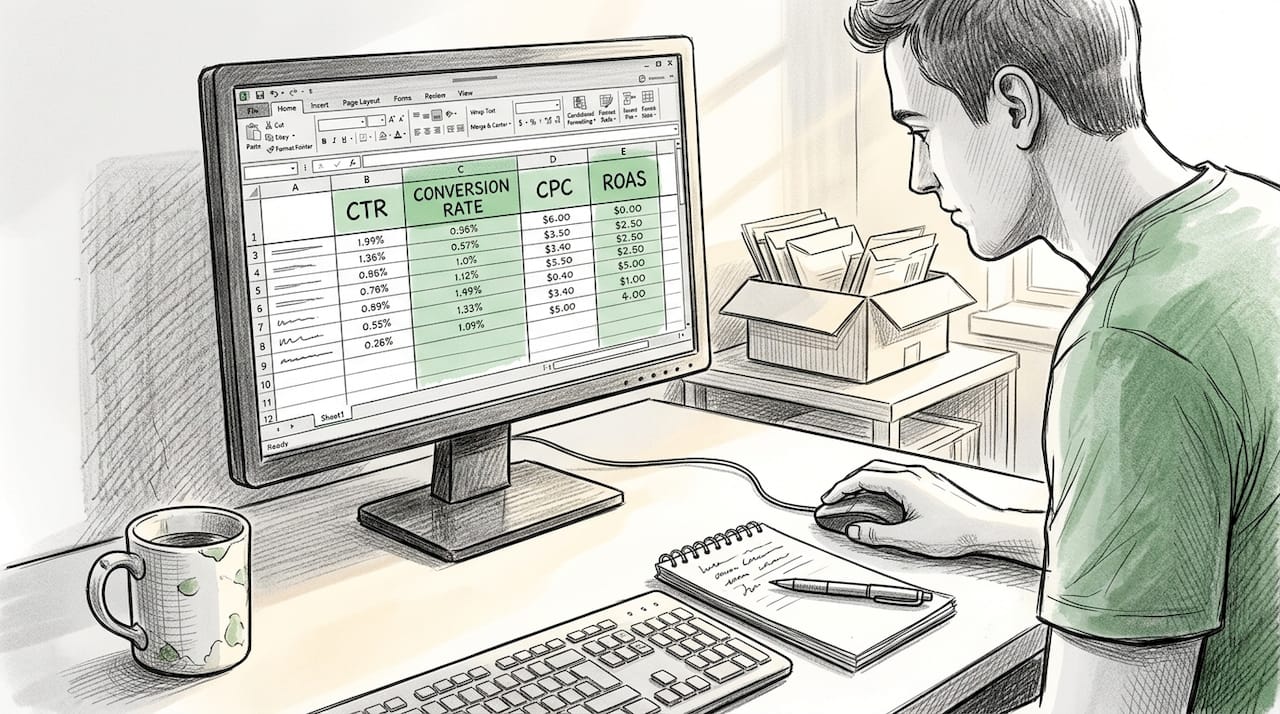
The goal is not to track everything. It is to track the right things and act on what you find.
Click-through rate (CTR): Measuring listing appeal and ad relevance
CTR measures how often someone clicks your ad after seeing it. The formula is simple: divide total clicks by total impressions, then multiply by 100 to get a percentage. A CTR of 2% means that for every 100 people who saw your ad, two clicked on it.
This metric tells you how appealing your listing is at first glance. Your main photo, title, price, and star rating all influence whether someone stops scrolling and clicks. A low CTR almost always points to a creative or relevance problem, not a budget problem.
CTR benchmarks for Etsy ads:
- Under 1%: Poor. Your listing likely needs stronger visuals or a more compelling title.
- 1 to 2%: Average. There is room for improvement.
- 2 to 3%: Good. Your listing is resonating with shoppers.
- 3 to 5%: Excellent. You are outperforming most sellers on the platform.
According to CTR benchmarks for Etsy ads, the average CTR sits between 1 and 2%, with top performers reaching 3 to 5%. If you are below 1%, the priority should be testing new thumbnail images and rewriting your title before increasing your budget.
When diagnosing a low CTR, start with your main listing photo. It is the single biggest driver of clicks. High-contrast images, lifestyle photos, and clean backgrounds tend to outperform cluttered or dark shots. After images, look at your title. It should lead with the most searchable, descriptive terms.
To optimize images and titles effectively, align your keywords with what buyers are actually searching for. This improves both your organic ranking and your ad relevance score, which can reduce your CPC over time.
Strategies to increase Etsy listing clicks include A/B testing your main photo, using natural lighting, and front-loading your title with high-intent keywords.
Pro Tip: Run two versions of the same listing with different main photos for 14 days. Compare CTR between them and keep the winner. Small creative changes can double your click volume without touching your budget.
Conversion rate: Turning clicks into sales and understanding campaign quality
Conversion rate measures how many of your ad clicks result in an actual purchase. It is calculated by dividing total orders by total ad clicks, then multiplying by 100. A 3% conversion rate means three out of every 100 clicks led to a sale.
This metric is one of the clearest signals of listing quality. If people are clicking but not buying, something in your listing is creating friction. That could be pricing, unclear photos, weak descriptions, or missing size and material details.
Conversion rate benchmarks to know:
| Traffic source | Benchmark range | |---|---| | General Etsy traffic | 1 to 5% | | Etsy ad clicks | 2 to 4% | | Global ecommerce average | ~2.9% |
Conversion rate benchmarks show that Etsy shops average between 1 and 5%, with ad clicks targeting 2 to 4% for healthy performance. The global ecommerce average hovers around 2.9%, giving you a useful external reference point.
How to improve your conversion rate:
- Audit your listing photos. Show the product from multiple angles and include scale references.
- Sharpen your description. Answer the top three questions buyers have before purchasing.
- Check your pricing. Compare against similar listings to confirm you are competitive.
- Add social proof. Highlight review counts and star ratings prominently.
- Reduce friction. Make shipping timelines and return policies easy to find.
Scaling ad spend on a listing with a low conversion rate wastes money. Fix the listing first, then increase budget. This sequence protects your ROAS and prevents you from paying for traffic that will not convert.
For a deeper look at improving results, the Etsy conversion rate guide covers listing-level tactics that directly impact your ad performance. You can also review Etsy conversion performance data across different shop categories for additional context.
Pro Tip: Filter your ads dashboard by listing to find which products have the highest conversion rates. Shift your ad budget toward those listings and pause the ones consistently below 1%.
Cost per click (CPC) and ROAS: Balancing ad spend and profit
CPC is what you pay each time a shopper clicks your ad. ROAS, or return on ad spend, tells you how much revenue you generate for every dollar spent. ROAS is calculated by dividing total revenue from ads by total ad spend.
CPC benchmarks on Etsy typically range from $0.10 to $1.50, with an average of $0.25 to $0.50. For comparison, Google Ads averages around $0.66 per click and Amazon sits between $0.50 and $1.00. Etsy's CPC is generally competitive, but costs vary by category and competition level.
Platform CPC and ROAS comparison:
| Platform | Average CPC | ROAS target | |---|---|---| | Etsy | $0.25 to $0.50 | 3 to 5x | | Google Ads | ~$0.66 | 4 to 6x | | Amazon | $0.50 to $1.00 | 3 to 4x |
ROAS benchmarks show that Etsy's platform average sits around 2.9x, but most sellers need 3 to 5x to stay profitable after fees and production costs. Anything under 2x typically means your ads are losing money.
Before spending on ads, calculate your break-even ROAS using this formula:
Break-even ROAS = 1 divided by your profit margin. For a 40% margin, break-even ROAS is 2.5x.
If your profit margin is 30%, your break-even ROAS is 3.3x. That means you need to earn $3.30 in revenue for every $1 spent on ads just to cover costs. Use the ROAS break-even guide to run these numbers for your specific shop before launching any campaign.
For a structured approach to hitting these targets, the 30-day Etsy ads strategy outlines a week-by-week plan for testing, scaling, and optimizing campaigns based on live KPI data.
Advanced tracking: Tools and strategies for data-driven Etsy ads
Etsy provides two primary tracking tools: the Ads dashboard and Shop Stats. Both are useful, but they serve different purposes.
- Ads dashboard: Shows listing-level data including impressions, clicks, CPC, and ROAS. Use this to identify which specific listings are profitable and which are draining budget.
- Shop Stats: Provides funnel-level data showing how shoppers move from views to clicks to purchases. This helps you identify where drop-off occurs.
- Listing-level analytics: Segment performance by individual product to find patterns. Some listings convert well with low traffic; others attract clicks but fail to close.
To track Etsy ad conversions accurately, especially when running external ads on Facebook, TikTok, or Google, you need tools that go beyond Etsy's native dashboard. Etsy's built-in data does not always connect external ad clicks to purchases, which creates attribution gaps.
Use Etsy Shop Stats and advanced tracking to segment your funnel and track AOV alongside ROAS. A high ROAS on a low-AOV product may still be less profitable than a moderate ROAS on a high-AOV item.
A practical weekly review process:
- Check ROAS for all active listings. Pause any below your break-even threshold.
- Review CTR. Flag listings under 1% for creative testing.
- Check conversion rate. Investigate listings with CTR above 2% but conversion below 1%.
- Monitor CPC trends. Rising CPC with flat ROAS signals increasing competition.
- Calculate AOV and margin impact. Make sure revenue numbers reflect actual profit.
Pro Tip: Start with a daily budget of $3 to $10 per day, which is roughly 5 to 10% of your current revenue. This range gives you enough data to make informed decisions without overcommitting spend before you know what works.
Our take: What most Etsy KPI guides get wrong
Most articles about Etsy KPIs focus heavily on dashboards and tracking tools while skipping the more important foundation: your listings and SEO. No amount of data analysis will save a listing with a weak photo or a title that does not match buyer search intent. Organic performance is the strongest signal you have. If a listing does not convert organically, ads will not fix it.
Another common mistake is applying universal ROAS benchmarks without accounting for Etsy's actual fee structure. Etsy charges a 6.5% transaction fee, plus listing and payment processing fees. These costs directly affect your real profit margin, which means your personal break-even ROAS is almost always higher than the platform average. Use the break-even math for Etsy ROAS to calculate your specific threshold before setting any campaign targets.
Chasing averages is also a trap. A 2.5x ROAS might be excellent for a high-margin digital product and catastrophic for a handmade item with 20% margins. The goal is not to match benchmarks. It is to understand why a metric is where it is and whether fixing it is a listing problem, a targeting problem, or a budget problem.
Pro Tip: Before spending a single dollar on ads, run the break-even formula for every listing you plan to promote. It takes five minutes and prevents weeks of unprofitable spend.
Supercharge your Etsy ad performance with IndiePixel
Tracking KPIs inside Etsy's native tools is a good starting point, but it leaves significant gaps, especially when you run ads on Facebook, TikTok, or Google. Those platforms need accurate purchase signals to optimize delivery, and Etsy's default setup does not send that data back reliably.
IndiePixel ad tracking bridges that gap by capturing purchase events and syncing conversion data directly to your ad platforms. This means your campaigns optimize toward actual sales, not just clicks. You also get a unified dashboard that brings all your KPIs together in one place. Before you scale spend, use the Etsy cart checker to validate product demand and avoid wasting budget on listings that are not ready to convert.
Frequently asked questions
What is a good ROAS for Etsy ads in 2026?
Most experts suggest a ROAS target of 3 to 5x for profitable Etsy ad campaigns in 2026. Under 2x typically means you are losing money after fees and costs.
How long should you let an Etsy ad campaign run before judging results?
Let campaigns run for at least 30 days minimum before making major changes, but review metrics weekly to catch early signs of underperformance.
Which metric is most important for Etsy ad success?
ROAS is generally the single most important metric because it directly shows how much revenue your ads return for every dollar spent, as Etsy's advertising guidance confirms.
How can you improve your Etsy ad conversion rate?
Improve your conversion rate by optimizing product images, refining titles and descriptions, and ensuring competitive pricing, all of which align with Etsy's conversion benchmarks of 2 to 4% for ad clicks.
What tools or dashboards help track Etsy ad KPIs?
Etsy's Ads dashboard and Shop Stats offer essential tracking, while platforms like IndiePixel provide more advanced analytics and multi-channel attribution for sellers running external ad campaigns.