Etsy Ads mastery: Advanced strategies to boost sales
Learn advanced Etsy Ads strategies top sellers use to drive real sales. Covers listing selection, campaign setup, ROAS benchmarks, and scaling frameworks.

Most Etsy sellers assume that spending more on ads automatically means more sales. It doesn't. Etsy Ads can absolutely drive profitable growth, but only when you apply the right strategy behind the budget. Sellers who treat ads like a magic switch often burn through their budgets with little to show for it. The ones who succeed treat Etsy Ads as a data-driven system that rewards preparation, patience, and precision. This guide breaks down the advanced frameworks top sellers actually use, covering campaign structure, listing selection, creative optimization, and scaling methodology so you can stop guessing and start growing.
Table of Contents
- How Etsy Ads actually work: Demystifying the algorithm
- Which listings to promote: The proven-performance selection framework
- Optimizing listings for ad success: What top sellers do differently
- Campaign setup and optimization: Budgeting, scaling, and pitfalls
- What most guides miss about Etsy Ads strategy
- Take your Etsy Ads to the next level with advanced tracking
- Frequently asked questions
Key Takeaways
| Point | Details | | --- | --- | | Start with proven winners | Only advertise listings with strong organic sales and healthy margins for best ROI. | | Optimize before spending | Fine-tune your SEO, listing images, and reviews before investing in ads to amplify success instead of waste. | | Follow data-backed frameworks | Run small, controlled tests (3-5 listings, 30 days) and scale based on incremental ROAS improvements. | | Beware of common pitfalls | Avoid scaling too quickly, advertising every listing, or expecting ads to fix fundamental listing issues. | | Track and adapt with the right tools | Use advanced analytics to track campaign performance and optimize your ad spend intelligently. |
How Etsy Ads actually work: Demystifying the algorithm
Before you can optimize your campaigns, you need to understand what's happening under the hood. Etsy Ads run on an auction mechanics system. Every time a buyer searches on Etsy, an automated auction determines which ads appear and in what position.
The platform uses a cost-per-click (CPC) model where you set a daily budget and Etsy's algorithm optimizes placements. You only pay when someone clicks your ad. Budgets start at just $1 per day, making the barrier to entry low. But low barriers don't mean low complexity.
Etsy's algorithm weighs several factors when deciding which ads to show:
- Listing quality score: How well your listing converts organically
- Bid amount: Your willingness to pay per click relative to competitors
- Buyer intent signals: How closely the buyer's search matches your listing
- Recency and engagement: Favorites, recent sales, and click-through history
Understanding CPC averages matters for ad budget planning. Average CPCs range from $0.10 to $1.50, with most sellers landing between $0.15 and $0.60 per click. Categories like jewelry and personalized gifts tend to sit at the higher end.
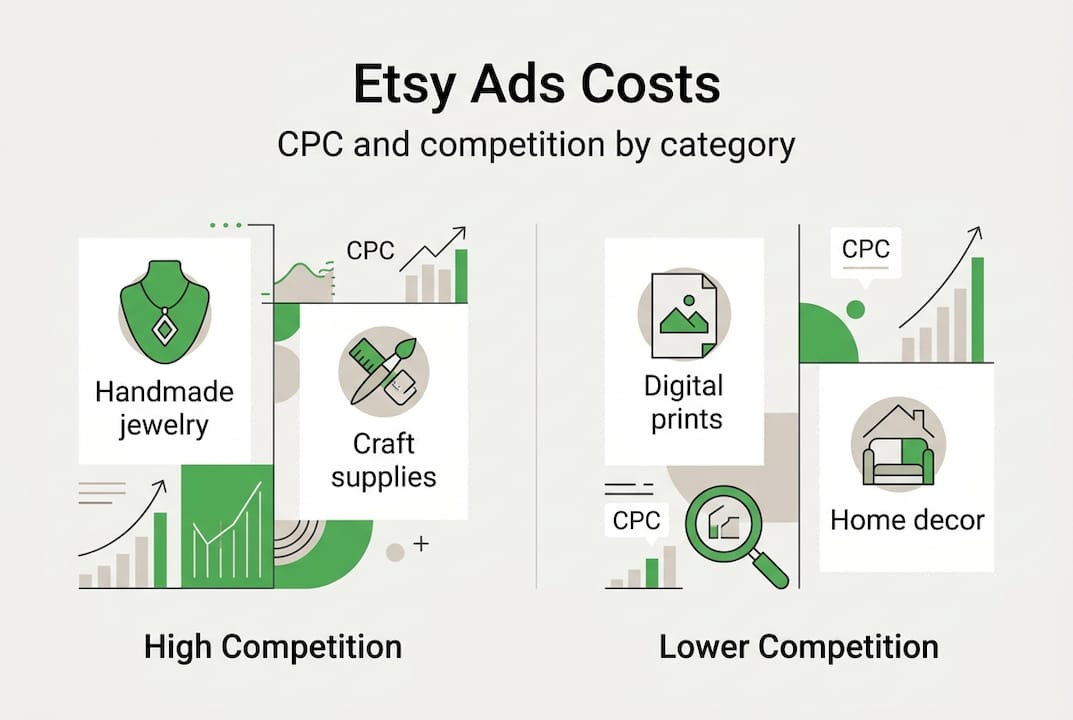
| Category type | Typical CPC range | Competition level | |---|---|---| | Handmade jewelry | $0.50 to $1.50 | High | | Digital downloads | $0.10 to $0.40 | Medium | | Home decor | $0.20 to $0.70 | Medium | | Personalized gifts | $0.60 to $1.50 | High | | Vintage items | $0.10 to $0.35 | Low to medium |
One critical point: Etsy's machine learning system needs consistent data to optimize your placements effectively. Running a campaign for fewer than 30 days and making constant changes prevents the algorithm from learning. Expect modest click-through rates (CTR) and conversion rates early on. Measuring what actually matters, such as ROAS and ad conversion rate, is far more useful than reacting to daily fluctuations.
Which listings to promote: The proven-performance selection framework
Knowing how Etsy Ads function, the next step is selecting which listings will generate real ROI. This is where most sellers go wrong. Ads amplify what's already working. They do not fix broken listings.
Promoting a listing with poor photos, weak SEO, or thin margins is one of the fastest ways to drain your budget. Before you spend a dollar, filter your listings using these criteria for which listings to promote.
Here's a step-by-step selection process:
- Pull your organic performance data. Look at each listing's organic views, favorites, and conversion rate over the past 60 to 90 days.
- Filter for proven converters. Only advertise listings with 1.5 to 2%+ conversion rates, at least 5 to 10 organic sales, strong photos, and reviews.
- Evaluate profit margins. Target listings with at least $10 in profit after production, shipping, and Etsy fees. Thin margins get wiped out fast under ad spend.
- Check social proof. Listings with 10+ reviews and a 4.5+ star rating convert paid traffic significantly better.
- Assess creative quality. Your thumbnail is your ad. If it doesn't stop a scroll, it won't convert a click.
| Criteria | Ad-ready listing | Not ad-ready | |---|---|---| | Organic conversion rate | 2.1% | 0.4% | | Total sales | 34 | 2 | | Profit margin | $18 per sale | $4 per sale | | Review count | 22 reviews, 4.8 stars | 1 review, 3 stars | | Photo quality | Professional, 5 images | Single, low-res photo |
For conversion rate improvement, focus on listings that already show buyer interest organically. Ads will push those signals further.
Pro Tip: Avoid advertising low average order value (AOV) items in highly competitive categories. Even a $0.40 CPC can destroy margins on a $12 product with a 1.5% conversion rate.
Optimizing listings for ad success: What top sellers do differently
Now that you know which listings to promote, let's ensure they're prepped to convert paid clicks. Top sellers don't just select good listings. They actively prepare them before turning on ads.

The foundation is SEO alignment. Your listing title, tags, and attributes must match the search terms buyers actually use. Ads boost organic rankings through engagement signals like favorites and sales, but poor listings lead to wasted spend even with perfect targeting. Fix your SEO for ads first.
Here's the essential optimization checklist before running ads:
- Title: Lead with your primary keyword, not your brand name. Keep it descriptive and buyer-focused.
- Tags: Use all 13 tags. Mix broad and long-tail phrases that reflect real buyer searches.
- Photos: Use all 10 photo slots. Show scale, lifestyle context, and product detail. Your first image is your ad creative.
- Pricing: Research competitors. Being 10 to 15% above market average requires stronger social proof to convert.
- Reviews: Actively request reviews from recent buyers. Listings below 10 reviews convert paid traffic poorly.
The impact of photo quality on paid traffic is well documented. Photo optimization lifted CTR 33% and conversion 89% in one jewelry shop case study, contributing to 103% revenue growth to $47,848 in just 30 days.
"We updated our main listing photos to show the product in use and added a size comparison image. Within 30 days of running ads on those updated listings, our revenue more than doubled." — Etsy jewelry seller, OptiShop case study
For listing optimization before paid traffic, treat every element as a conversion variable. Each one either helps or hurts your result.
Pro Tip: Test thumbnails and titles with a small daily budget ($1 to $2) for 7 days before scaling. Use click-through rate as your signal. If CTR is below 0.5%, the creative needs work before you invest more.
Campaign setup and optimization: Budgeting, scaling, and pitfalls
With optimized listings selected, it's time to launch and manage your campaigns for data-driven growth. The methodology here is deliberate and patient.
Follow this numbered framework for campaign setup:
- Start small and focused. Run $1 to $5 per day on 3 to 5 top-performing listings. Don't spread your budget across 20 listings at launch.
- Commit to 30 days. Run campaigns for 30 days without interruption to gather meaningful data. Early changes reset the algorithm's learning process.
- Track the right benchmarks. Monitor CTR, ad conversion rate, and ROAS weekly. Key benchmarks are CTR 1 to 3%, ad conversion 2 to 5%, and ROAS target 3x+, with an industry average of 2.8x.
- Scale winners incrementally. Increase budget on top performers by 10 to 20% per week. Avoid doubling budgets overnight.
- Pause underperformers strategically. After 14 to 30 days, pause listings with ROAS below 2 to 3x. Don't pause earlier.
- Use long-tail keywords. If Etsy allows keyword targeting in your region, prioritize specific, lower-competition phrases.
New shops face a steeper curve. Shops with fewer than 50 sales typically see success rates of 30 to 40% and ROAS of 1.5 to 2.5x. Low-margin, seasonal, or low-AOV items compound the challenge. For ROAS benchmarks and break-even calculations, know your numbers before you commit budget.
The 30-day playbook approach works because it respects how machine learning systems function. Consistency of data input leads to better output.
Pro Tip: Immediate tweaks after launch feel productive but often hurt results. Trust the data collection phase. Optimize only after you have statistically meaningful click and conversion volume.
What most guides miss about Etsy Ads strategy
Here's the part most mainstream guides skip: Etsy Ads are not the right tool for every seller, and pretending otherwise leads to real financial losses.
Established shops with high-margin products and proven listings can see ROAS of 4 to 6x. New shops or sellers with low-AOV products often find ads unprofitable and are better served by building organic SEO first. This isn't a failure. It's a sequencing decision.
The sellers who win with Etsy Ads share one trait: they use ads to amplify listings that already work. They don't use ads to rescue underperforming products or test unproven concepts at scale. They build quality first, then use organic SEO strategies to establish baseline traffic and conversion data before adding paid spend on top.
Blindly increasing ad spend on unproven listings is one of the most common and costly mistakes sellers make. The math doesn't change just because you're spending more. If a listing converts at 0.8% organically, paid traffic won't fix that. More clicks at the same conversion rate means more spend with the same poor outcome.
Pro Tip: Before running any campaign, calculate your break-even ROAS. Divide your revenue per sale by your profit per sale. That number tells you exactly how much ad spend you can absorb before losing money. True profitability lives in that calculation.
Take your Etsy Ads to the next level with advanced tracking
You now have the strategy, benchmarks, and frameworks. The next step is putting them into action with tools that give you real visibility into what's actually working.
IndiePixel is built specifically for Etsy sellers who want to go beyond Etsy's native reporting. With advanced Etsy ad tracking, you can connect your ad campaigns on Facebook, TikTok, and Google to actual purchase data, so you know which campaigns drive real sales, not just clicks. The platform syncs conversion data back to your ad platforms, giving the algorithms the signals they need to optimize toward buyers. You can also use the cart checker tool to validate conversion performance before scaling your spend. Stop operating on incomplete data and start making decisions backed by attribution you can trust.
Frequently asked questions
What is the minimum daily budget for Etsy Ads?
The minimum daily budget you can set for Etsy Ads is $1 per day, making it accessible for sellers at any stage.
What is a good ROAS for Etsy Ads?
A good ROAS for Etsy Ads is 3x or higher, though the industry average sits around 2.8x. Established shops with strong listings often achieve 4 to 6x.
How long should you run an Etsy Ads campaign before making changes?
Run your campaign for at least 30 days without changes to allow the algorithm to collect enough data for meaningful optimization.
Do Etsy Ads help improve organic search rankings?
Yes. Ads boost organic rankings by generating engagement signals like favorites and sales, which Etsy's algorithm interprets as quality indicators.
Why do some Etsy Ads campaigns lose money?
Campaigns typically lose money when promoting unoptimized or low-margin listings, or when sellers make changes too early and reset the algorithm's learning phase.
Recommended
- Etsy Ads Strategy: A Practical 30-Day Playbook
- IndiePixel | Etsy Ad Tracking for Facebook, TikTok, and Google Ads
- How Etsy Ads Are Placed: Auction Mechanics and Practical Implications
- Etsy SEO for Sellers Running Ads: Titles, Tags, and Attributes
- Using Google Ads Effectively - Titan Blue Australia
- A Practical Guide to Profitable Amazon Ad Campaigns – Reddog Consulting Group