Stop Guessing: Data-Driven Etsy Ad Spend for Better ROI
Discover why remove ad spend guessing when you can use data to boost your Etsy ROI. Learn to spend smarter and increase your profits!

Spending money on Etsy ads without reliable data is one of the fastest ways to drain your budget with little to show for it. Guessing wastes 20-50% of budget on listings that simply do not convert, while data reveals the exact search terms and conversion rates needed to focus spend and achieve 3x or better ROAS (Return on Ad Spend). This guide breaks down why guesswork is so costly for Etsy sellers, how to replace it with clear data-driven habits, and what a repeatable process for smarter ad spending actually looks like in practice.
Table of Contents
- The hidden costs of ad spend guessing
- How data-driven insights unlock ad profitability
- Common ad spend guessing mistakes and how to fix them
- A repeatable process to eliminate ad spend guessing
- Why mastering ad spend is more mindset than math
- Take the guesswork out of Etsy ads with IndiePixel
- Frequently asked questions
Key Takeaways
| Point | Details | | --- | --- | | Guesswork wastes ad budgets | Relying on intuition alone leads to overspending on poor performers and lowers overall returns. | | Data reveals what works | Tracking conversion rates and keyword results lets you focus spend for maximum ROI. | | Mistake prevention is critical | Avoid advertising all listings or new items without proven results to prevent wasted spend. | | Process beats one-time fixes | A repeatable review and reallocation process ensures ad efficiency keeps improving. |
The hidden costs of ad spend guessing
Most Etsy sellers start running ads the same way: they pick a few listings, set a daily budget, and wait to see what happens. There is no baseline performance data, no conversion benchmarks, and no defined criteria for deciding what stays or gets turned off. This approach feels like progress, but it is largely guessing disguised as action.
Why does this happen? A few reasons are consistently at play:
- No centralized attribution data. Etsy's built-in reporting shows clicks and revenue, but it does not connect specific ad spend to confirmed purchases by source. Without that link, sellers cannot tell which listing or keyword actually produced the sale.
- Pressure to promote every listing. Many sellers assume that advertising more products means more exposure and more sales. In practice, spreading a limited budget across 20 or 30 listings dilutes impact significantly.
- No visibility into keyword relevance. Without search term reports reviewed regularly, ad budgets flow toward broad, competitive terms that generate clicks but rarely convert to orders.
- No clear "pause" criteria. Without performance thresholds defined ahead of time, sellers keep underperformers running far longer than they should.
The typical symptoms of ad spend guessing are easy to recognize. You see clicks but few purchases. Your ROAS fluctuates without a pattern you can act on. You have no way to identify which listings actually drive profit. And you never find a clear path to scaling up what works. As ad spend guessing leads to wasted budgets on unoptimized listings, irrelevant keywords, and poor performers, the result is consistently negative ROAS.
Sellers who have explored proven Etsy ad strategies know that the difference between a profitable campaign and a money pit often comes down to whether you are reacting to real data or reacting to feelings about your products.
"Without tracking conversion data at the listing level, you are essentially funding an experiment with no control group and no clear hypothesis."
Pro Tip: Before allocating any budget increase to a listing, verify that you have at least 7 to 14 days of conversion data for that listing at its current spend level. Scaling spend before you have reliable data simply amplifies waste, not results.
Exploring best practices for Etsy ads consistently reinforces one core truth: data collection comes before budget decisions, not after.
How data-driven insights unlock ad profitability
Replacing guesswork with data does not require a large analytics team or complex software. It does require commitment to reviewing performance numbers on a regular schedule and making spend decisions based on what those numbers actually say.
Data-driven ad management for Etsy sellers typically looks like this: daily monitoring of total spend versus revenue, weekly review of conversion rates by listing, and monthly analysis of keyword performance to identify which search terms are generating actual purchases versus just clicks. Each review cycle feeds directly into a budget reallocation decision.
The key metrics to monitor are:
- Conversion rate by listing. This is the percentage of ad clicks that result in a completed purchase. A strong conversion rate means the listing's photos, price, and description are doing their job. A low rate signals a listing problem, not an ad problem.
- ROAS. For every dollar you spend on ads, how many dollars in revenue do you get back? A ROAS below 1.0 means you are losing money on that ad. Most sellers should target a minimum ROAS of 2.0 to 3.0 to maintain profitability after Etsy fees and product costs.
- Search term performance. Using search term data shows exactly which queries trigger your ads and which of those queries actually convert. This is one of the fastest ways to cut wasted spend.
- Cost per click (CPC) trends. Rising CPC on a term that converts well may still be worthwhile. Rising CPC on a term with no conversions is a clear signal to stop bidding.
Guessing vs. data-driven approach
| Factor | Guessing approach | Data-driven approach | |---|---|---| | Budget allocation | Spread across all listings | Focused on proven converters | | Keyword selection | Broad, intuition-based | Based on actual search term reports | | Performance review | Rarely, or only when concerned | Weekly, on a fixed schedule | | Pause/scale decisions | Based on "feeling" | Based on ROAS and conversion thresholds | | ROI outcome | Inconsistent, often negative | Improving over time with each review cycle | | Stress level | High, uncertain | Lower, predictable |
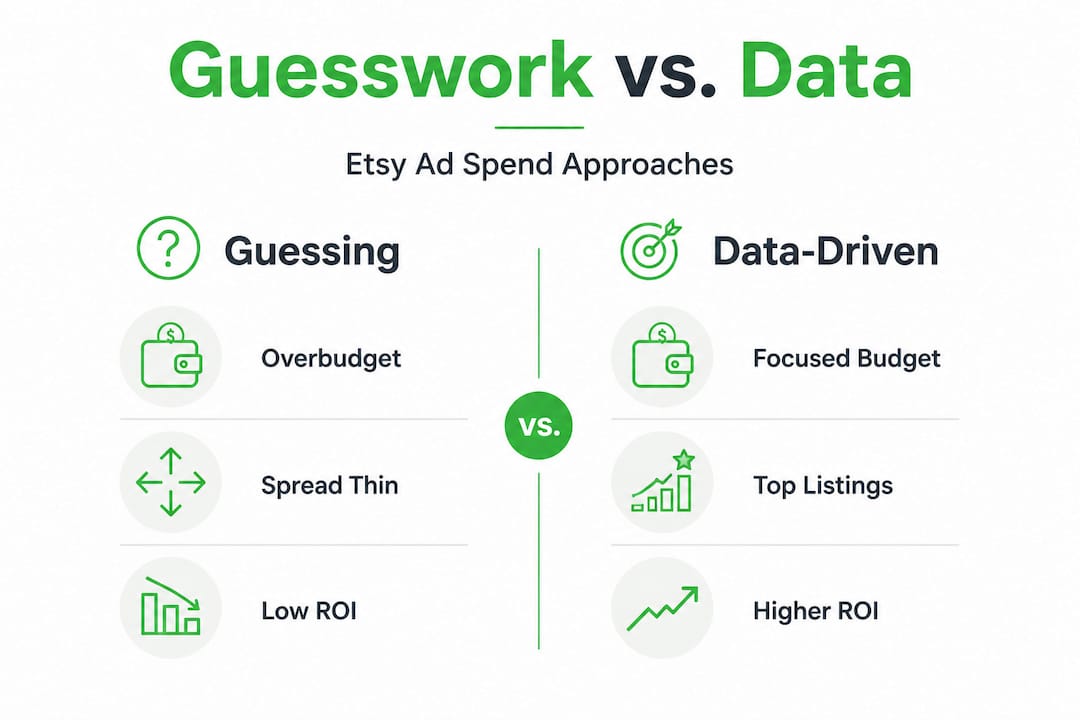
The shift to data-driven ad management is gradual but compounds quickly. Applying analytics for Etsy ads shows that sellers who commit to a regular review cycle typically see measurable ROAS improvement within 30 to 60 days simply by cutting spend on poor performers and redirecting it to proven listings.
Here is a numbered action plan for making the shift:
- Collect baseline data first. Run ads at a conservative budget for at least two weeks before making any major changes. You need a data foundation before you can optimize.
- Review conversion rates by listing. Sort your listings by conversion rate, not by total clicks or revenue. High clicks with low conversion means a listing problem, not a targeting problem.
- Identify your top performers. Find the listings generating a ROAS above your target threshold. These are your scaling candidates.
- Focus spend on verified winners. Pause or reduce budget for any listing with consistent negative ROAS after two or more review cycles.
- Refine keywords based on actual data. Remove irrelevant search terms from your ad targeting. Add negative keywords where the platform allows. Reinvest freed budget into higher-performing terms.
The data waste reality is well documented: guessing burns 20 to 50% of your budget on non-converters, while focused data-driven spend can push ROAS to 3x or beyond.
Common ad spend guessing mistakes and how to fix them
Even sellers who want to use data often fall into predictable patterns that undermine their results. These three mistakes appear repeatedly and each one has a clear fix.
Mistake 1: Advertising every listing. Running ads on 25 listings with a $10 daily budget gives each listing roughly $0.40 per day. At that level, no single listing gets enough impressions or clicks to generate statistically useful conversion data. You end up with fragmented, inconclusive results across the board.

Mistake 2: Pushing new listings into ads immediately. New listings have no purchase history, no reviews, and no established conversion rate. Putting significant ad budget behind them before they have any organic traction means you are paying for data collection at full price. A smarter approach is to let new listings gather initial traffic organically, then introduce paid promotion once there is baseline performance data to work from.
Mistake 3: Keeping low-converting items in the ad rotation. Unoptimized listings and poor performers drag down overall ROAS consistently. Many sellers keep these running because they hope performance will improve. Without changes to the listing itself, photos, pricing, or description, the conversion rate rarely improves on its own.
Performance breakdown by mistake
| Listing type | Monthly ad spend | Conversion rate | Outcome | |---|---|---|---| | Spread across all 25 listings | $300 | 0.8% average | Negative ROAS, no clear winners | | New listing with no history | $100 | 0.3% | High cost per acquisition, no profit | | Low-converter kept active | $150 | 0.5% | Consistent budget drain, negative return | | Proven winner with focused spend | $150 | 4.2% | Positive ROAS, scalable results |
The fixes for each mistake are straightforward:
- Focus on proven winners first. Identify the 3 to 5 listings with the best historical conversion rates and concentrate your budget there before worrying about expanding to new listings.
- Test new listings in small batches. Allocate a small test budget, $1 to $2 per day, to a new listing for two weeks. If conversion data looks promising, increase spend gradually. If it does not convert, fix the listing before spending more.
- Validate with data before scaling. Never increase budget on a listing that has not yet demonstrated a positive ROAS. Scaling an underperformer does not fix the underlying conversion problem, it just amplifies the loss.
- Review what is not converting and act fast. Improving conversion rates before scaling ads is one of the highest-value activities any Etsy seller can do. A 1% improvement in conversion rate on a top listing can double or triple the return on every ad dollar spent.
Pro Tip: Set a specific ROAS threshold, for example 1.5x, as your minimum standard. Any listing that consistently falls below that threshold after two full review cycles gets paused immediately and moved to a listing improvement queue before being reconsidered for promotion.
A repeatable process to eliminate ad spend guessing
Having the right data is only part of the solution. The other part is building a repeatable workflow that makes data review a regular habit rather than an occasional activity. This five-step framework keeps your ad campaigns running on evidence, not instinct.
- Audit your current data. Pull conversion reports, ROAS data, and search term performance for the past 30 days. Identify your top three converters and your bottom three performers by ROAS.
- Identify listings worth scaling. Any listing with a ROAS above your target threshold and a conversion rate above 2% is a candidate for increased budget. Prioritize these before touching anything else.
- Refine your keyword targeting. Remove search terms that have received 10 or more clicks with zero conversions. Add those terms as negatives where the platform allows. Focus remaining budget on terms with proven purchase intent.
- Set a weekly review date. Block 30 minutes on the same day each week for performance review. Consistent timing builds the habit and ensures no underperformer runs unchecked for weeks.
- Optimize or pause based on thresholds. Every listing either meets your ROAS target, is trending toward it, or gets paused. There is no middle ground. Paused listings move to a fix list, not to the trash, so you can revisit them after making listing improvements.
If you are just starting with this approach, these practical tips will help you build momentum:
- Start with just 3 to 5 listings rather than your entire catalog.
- Use a simple spreadsheet to log weekly ROAS and conversion rate by listing until you have a tool that does this automatically.
- Set calendar reminders for your weekly review. Consistency matters more than perfection in the early weeks.
- Following an Etsy ads 30-day playbook gives you a structured timeline so the first month does not feel overwhelming.
The real power of this process is compounding. Each week you pause a poor performer and redirect that budget to a winner, your overall ROAS improves. Over 90 days, sellers who follow this consistently often find their effective ad budget has nearly doubled in efficiency without spending an additional dollar. As the data confirms, focusing spend based on real search term and conversion data routinely produces 3x or better ROAS for sellers who commit to the process.
Why mastering ad spend is more mindset than math
Here is something most Etsy ad guides will not tell you: the math is actually the easy part. Calculating ROAS, reading a conversion rate, identifying a losing keyword — these are all straightforward once you know what to look for. The harder challenge is building the discipline to act on that data consistently, even when it conflicts with your attachment to certain listings.
Many sellers believe the answer is a better tool or a new platform. In our experience, the sellers who generate lasting ad profitability are the ones who build a habit of systematic elimination, not the ones who have the most sophisticated software stack. A weekly 30-minute review that leads to one clear budget reallocation decision will outperform an elaborate analytics setup that nobody actually uses.
The other common belief worth challenging is that ad optimization is a one-time event. You do not set up a campaign, find a winning structure, and walk away. Markets shift, competition changes, seasonal demand fluctuates, and what converted well in January may underperform in June. Building long-term analytics habits is what separates sellers who maintain strong ROAS year over year from those who have one good month and then slide back into guessing.
Commit to the process. Review your data weekly. Pause what does not perform. Scale what does. This is not a complicated formula, but it does require consistency.
Take the guesswork out of Etsy ads with IndiePixel
Knowing what to track is one thing. Actually getting that data from your Etsy campaigns and your external ad platforms in one clear view is another challenge entirely. That is exactly what IndiePixel is built to solve.
IndiePixel's Etsy ad tracking platform captures purchase signals and sends conversion data back to Facebook, TikTok, and Google Ads so you can see which campaigns drive actual sales, not just clicks. The unified dashboard gives you attribution clarity across all your ad channels, while the cart checker for Etsy lets you validate listings before committing serious budget to them. If you are ready to stop guessing and start making every ad dollar accountable, IndiePixel gives you the data infrastructure to do exactly that.
Frequently asked questions
What is ad spend guessing and why is it risky for Etsy sellers?
Ad spend guessing means allocating your ad budget without reliable performance data to guide decisions. It risks wasting money on poor performers and consistently produces negative ROAS because spend flows to unoptimized listings and irrelevant keywords instead of proven converters.
How does using data help eliminate guessing in Etsy ad campaigns?
Tracking conversion rates and keyword performance lets you focus spend only on listings and terms that actually generate purchases. Data-driven focus cuts the 20 to 50% budget waste from non-converters and can lift ROAS to 3x or higher.
What mistakes do new Etsy ad users make most often?
The most common mistakes are advertising every listing at once, spending on new items with no sales history, and ignoring conversion data when deciding what to keep running. All three of these patterns lead to wasted ad budgets and negative ROAS.
How often should I review my Etsy ad performance data?
Review your ad performance data at least once per week. Weekly reviews give you enough data to make informed adjustments while ensuring that underperforming listings do not drain budget for extended periods before you catch them.