Boost Etsy views with paid ads: proven strategies for sellers
Learn how to boost Etsy shop views with paid ads. Covers listing optimization, budget strategy, troubleshooting, and data-driven scaling for Etsy sellers.

Getting more views on your Etsy shop through paid ads sounds straightforward, but most sellers discover quickly that spending money without a solid foundation produces frustrating results. Views stagnate, budgets shrink, and the algorithm feels like a black box. The difference between sellers who consistently grow their shop traffic and those who spin their wheels comes down to two things: listing readiness and data discipline. This guide walks you through every critical stage, from optimizing your listings before a single dollar is spent, to launching strategically, diagnosing performance problems, and scaling campaigns based on real numbers.
Table of Contents
- Get your listings ready: Optimization basics for paid ad success
- Launch paid ads strategically: Choosing listings, setting budgets, and timing
- Diagnose and fix: Handling low clicks, poor conversion, and shop trust
- Track, analyze, and scale: Measuring ad impact and maximizing views
- Why data-driven optimization outperforms guesswork on Etsy
- Etsy ad tracking tools: Take your campaigns further
- Frequently asked questions
Key Takeaways
| Point | Details | | --- | --- | | Optimize listings fully | Better titles, tags, photos, pricing, and shipping are essential for paid ads to drive more views. | | Choose proven products | Advertise listings with organic sales and conversion rates above 2% for the best results. | | Give ads time to work | Let paid campaigns run for at least 30 days to collect data and allow Etsy’s algorithm to optimize performance. | | Fix conversion bottlenecks | Troubleshoot poor clicks or sales with better photos, shop trust, and clear policies for higher conversions. | | Track and scale wisely | Monitor campaign performance and scale successful ads gradually using data-driven decisions. |
Get your listings ready: Optimization basics for paid ad success
Before running any paid ad, your listing needs to do most of the heavy lifting. Paid traffic amplifies what is already there. If your listing is weak, ads will simply accelerate your spend with nothing to show for it.
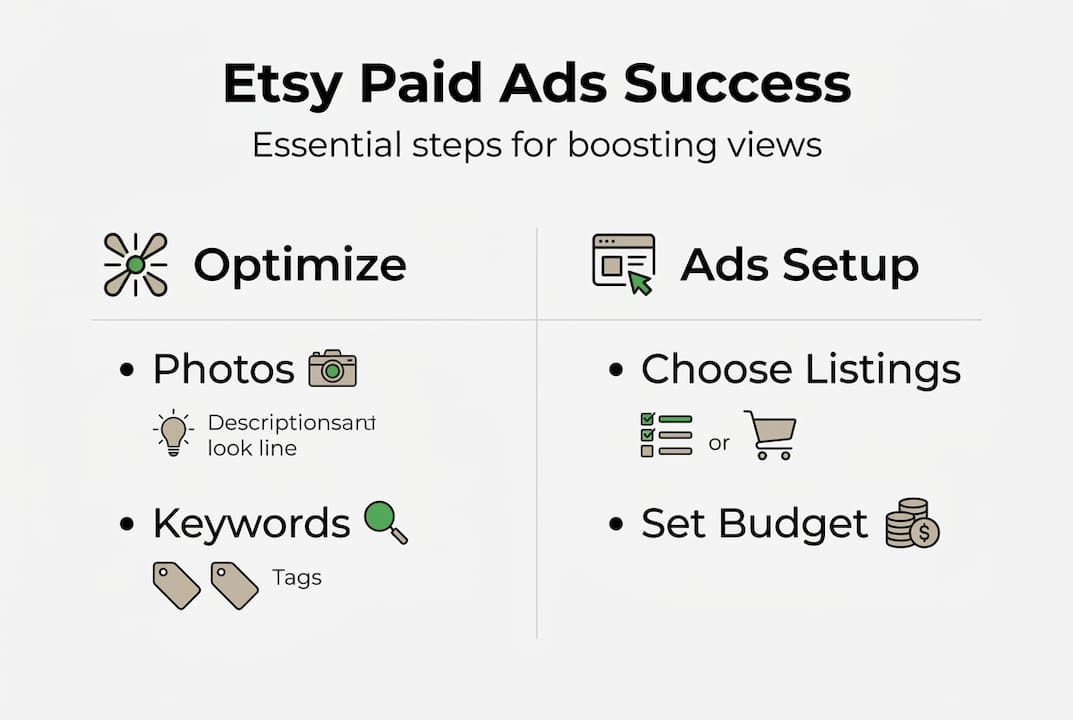
The Etsy Seller Handbook is clear on this: optimize all aspects of your listing before running ads, including titles, all 13 tags, attributes, photos, competitive pricing, and low shipping for better results. This is not optional groundwork. It is the foundation everything else sits on.
Here is what to check before activating any paid campaign:
- Titles: Lead with the most relevant, specific keyword a buyer would actually search. Avoid stuffing generic words. Think "sterling silver moon ring, adjustable band" not "beautiful ring gift."
- Tags: Use all 13 available tags. Mix exact phrases with broader variations. Tags and titles should reinforce each other without being identical.
- Attributes: Fill every attribute field your category allows. Etsy uses attributes to increase your views with attributes across relevant search filters. Sellers who skip these fields miss a significant visibility opportunity.
- Photos: Your first photo is your ad creative. It must be sharp, well lit, and show the product clearly. Lifestyle images in later slots help buyers visualize use.
- Pricing: Check competitor pricing in your niche. Being too far above market without a clear quality signal will kill your click-through rate.
- Shipping: Low shipping improves sales likelihood, confirmed by Etsy research from Q1 2024 across 6,000 US adults. Free or low-cost shipping is a measurable conversion factor.
For a deeper breakdown of keyword strategy applied to ads, the SEO for Etsy ads guide covers how to align titles and tags specifically for paid traffic performance.
| Listing element | Low optimization | High optimization | |---|---|---| | Title | Generic keywords | Specific, buyer-intent phrases | | Tags | Partial (5-8 used) | All 13 filled with varied phrases | | Photos | One basic product shot | 5+ images, lifestyle and detail | | Shipping cost | Standard or unspecified | Free or clearly discounted | | Attributes | Mostly blank | All relevant fields completed |
Pro Tip: Use Etsy's search visibility tool inside your listing editor to get direct feedback on how well your tags and titles are performing before you spend a dollar on ads. Fix any warnings first.
If you want a full walkthrough before launching, the listing optimization guide covers each element in detail with practical examples.
Launch paid ads strategically: Choosing listings, setting budgets, and timing
With listings fully optimized, the next decision is which ones to advertise and how to structure your initial spend. Many sellers make the mistake of running ads on their newest or favorite listings. Smart sellers run ads on listings that have already proven themselves organically.

The right approach to choosing listings for ads follows a clear logic: prioritize listings with at least one organic sale and a conversion rate above 2%. These listings have already shown that real buyers find them appealing. Paid ads will expand their reach, not introduce untested variables.
Follow this launch sequence:
- Select 3 to 5 proven listings. Avoid advertising listings with zero sales history or very low views.
- Set a daily budget of $1 to $5 per listing. Starting conservatively protects your spend while the algorithm learns.
- Allow at least 30 days before making any adjustments. As confirmed by Etsy's advertising guidance, running ads only on proven listings with a greater than 2% conversion rate and testing with a $1 to $5 daily budget for at least 30 days gives the algorithm time to optimize before you change anything.
- Monitor weekly, not daily. Daily fluctuations are normal. Weekly trends reveal actual patterns.
- Focus attention on listings with strong early impressions. High impressions with low clicks point to a listing-level issue, not a budget issue.
| Budget tier | Daily spend | Expected data window | Adjustment timing | |---|---|---|---| | Conservative | $1 to $3/day | 30 to 45 days | After full 30-day cycle | | Moderate | $3 to $5/day | 20 to 30 days | After 30-day cycle | | Scaling | $5 to $10/day | 15 to 25 days | After proven metrics |
The 30-day ads strategy breaks this timeline into weekly milestones so you know exactly what to look for at each stage.
Pro Tip: Do not pause ads after just a few days of low performance. Pausing and restarting resets the algorithm's learning cycle, which extends the time before you get reliable data.
Diagnose and fix: Handling low clicks, poor conversion, and shop trust
Once ads are live and collecting data, performance problems become visible. The key is knowing what each symptom points to and how to address it without guessing.
Two failure patterns show up most often:
- High views, low clicks: Your listing appears in search but buyers are not clicking. This usually means your primary photo is not compelling enough, your title does not match buyer intent, or your pricing is clearly misaligned with competitors.
- High clicks, low or no sales: Buyers are interested enough to visit but are not purchasing. This typically signals high shipping costs, missing product details, vague policies, or low shop trust signals.
To improve listing conversion, start with the specific element causing friction rather than overhauling everything at once.
A jewelry seller who redesigned listing images with better lighting and consistent backgrounds improved their click-through rate by 33% and their conversion rate by 89%, as cited in Etsy's own advertising guidance. That result came from a single focused change, not a complete listing rebuild.
For fixing view-to-click problems, check these elements:
- Replace the primary photo with a cleaner, higher contrast image
- Rewrite the title to lead with the most specific buyer term, not a generic category word
- Review competitor pricing on Etsy and adjust if you are more than 15% above market without a visible quality justification
For clicks-to-sale problems, focus on:
- Shipping cost and speed. Buyers abandon carts when shipping is unexpectedly high
- Product description completeness. Answer every likely buyer question within the listing itself
- Shop trust signals: completed About section, clear return policy, and recent reviews
Visual quality also matters beyond basic photography. Brands in competitive categories are increasingly using 3D model visuals to show product dimensions and material detail in ways standard photos cannot. This is especially effective for jewelry, home decor, and accessories.
The conversion rate guide provides a diagnostic checklist you can apply to any underperforming listing.
Pro Tip: Build shop trust before running ads. A shop with fewer than 5 reviews, an incomplete About section, and no stated return policy will consistently underperform even with excellent products and photos.
Track, analyze, and scale: Measuring ad impact and maximizing views
After troubleshooting issues, consistent measurement is what separates sellers who scale successfully from those who stay stuck at the same revenue level.
Start by tracking these key metrics for every active ad listing:
- Impressions: How often your listing appears in paid search results.
- Click-through rate (CTR): The percentage of impressions that result in clicks. Below 1% typically signals a photo or title problem.
- Conversion rate: The percentage of clicks that result in a purchase. Below 1% points to listing, pricing, or trust issues.
- Cost per click (CPC): What you pay for each visit. Compare this to your average order value to assess profitability.
- Revenue per ad spend (ROAS): Total revenue divided by total ad spend. A ROAS below 2x for most Etsy sellers means the campaign is not yet profitable.
Once you have 30 or more days of data, use it to decide what to scale and what to pause. Paid ads require 30 or more days of data for meaningful performance analysis. Organic SEO compounds results long term without ongoing cost, but is slower to ramp up. Running both strategies in parallel gives you faster visibility now and sustainable growth later.
For scaling campaigns, follow this sequence:
- Increase daily budget by no more than 20 to 30% at a time on proven listings
- Add new listings to ads only after they have shown organic traction
- Review how Etsy ads are placed in the auction system to understand what drives your ad position and cost
For a practical breakdown of which numbers to watch and when, tracking Etsy ad performance covers the essential KPIs with clear benchmarks.
Pro Tip: Export your Etsy Ads data monthly and compare listing-level performance side by side. Patterns across months reveal which listings are genuinely profitable and which ones are draining your budget quietly.
- Balance paid ads with organic improvements each month
- Rotate paused listings back into testing after making specific changes
- Avoid running ads during major Etsy platform-wide sales without adjusting your pricing strategy first
Why data-driven optimization outperforms guesswork on Etsy
Here is something most sellers do not want to hear: the listings you love most are rarely the ones buyers respond to. Sellers who rely on intuition about which listings to promote, which photos look best, or which price feels right consistently underperform against sellers who let actual data drive those decisions.
The uncomfortable truth from reviewing campaign after campaign is that pre-ad optimization is where most sellers fail. Not during the campaign. Not in the bidding strategy. Before the ad even runs. Sellers skip the listing optimization guide steps because they feel tedious, and then blame the platform when results disappoint.
Disciplined testing changes that. Sellers who run controlled tests, wait the full 30 days, track their numbers, and make one change at a time consistently improve their results. Patience is not passive. It is a competitive advantage. The sellers scaling their shops in 2026 are not finding magic tactics. They are doing the methodical work that everyone else skips.
Etsy ad tracking tools: Take your campaigns further
Optimizing listings and managing ad budgets gets you to a solid baseline. But if you want to understand exactly which campaigns are driving actual purchases, not just visits, you need attribution data that Etsy's native reporting does not provide.
IndiePixel gives Etsy sellers the conversion tracking infrastructure to connect ad spend directly to sales outcomes. Whether you are running campaigns on Facebook, TikTok, or Google Ads, IndiePixel sends purchase signals back to each platform so your campaigns optimize on real results. The cart checker tool lets you validate buyer intent before scaling spend, adding an extra layer of confidence to every budget decision. If you are ready to remove the guesswork from your ad strategy, IndiePixel's ad tracking solutions are built specifically for Etsy sellers who want data they can act on.
Frequently asked questions
How long should I run Etsy ads before making changes?
Let Etsy ads run for at least 30 days to collect meaningful data and allow the algorithm to optimize results before making adjustments. Changing settings too early resets the learning process and produces unreliable data.
What's the best way to optimize an Etsy listing for paid ads?
Use relevant titles, fill all 13 tags and attribute fields, upgrade your photos, set competitive pricing, and offer low shipping. Listing optimization directly influences both your ad placement and your conversion rate once buyers land on the listing.
Why do I have high views but no sales on Etsy?
High views with low sales typically point to weak photos, misaligned pricing, or missing trust signals like shop policies and reviews. Photos, pricing, and trust are the three levers most sellers overlook when troubleshooting conversion problems.
Can organic Etsy SEO outperform paid ads for views?
Organic SEO compounds long term and builds visibility without ongoing ad spend, while paid ads deliver faster but temporary boosts. The most effective approach combines both, using ads to accelerate traffic while SEO builds a sustainable foundation.