Etsy ad performance: advanced data guide for sellers
Learn how to track, interpret, and scale Etsy Ads using real data. Master ROAS, CTR, and budgeting strategies to maximize your ad ROI in 2026.

You're spending on Etsy Ads, but you're not sure if your investment is actually paying off. That uncertainty is one of the most common frustrations among Etsy sellers running paid campaigns. The good news: your ad data tells a clear story when you know what to look for. This guide walks you through the exact tools, metrics, and frameworks you need to track performance accurately, identify what's working, and scale with confidence. From setting up campaigns correctly to reading ROAS and CTR like a pro, every step here is grounded in real data, not guesswork.
Table of Contents
- What you need before you start: Tools, data, and prerequisites
- Step-by-step: How to set up and track your Etsy Ads for actionable data
- Troubleshooting: Common mistakes, risk factors, and what to fix or pause
- Analyzing results: Benchmarks, ROI, and scaling strategies
- Our take: What most sellers get wrong and what really works
- Unlock smarter Etsy advertising with IndiePixel
- Frequently asked questions
Key Takeaways
| Point | Details | | --- | --- | | Start with strong listings | Only promote listings with proven sales, good photos, and SEO for best ad results. | | Focus on key metrics | Track ROAS, CTR, and conversion rate to gauge true ad performance and profitability. | | Avoid common mistakes | Don’t spread ad budget thin or make frequent changes that reset algorithm learning. | | Scale up after proven ROI | Increase budgets by 20-30% only after consistent 3x+ ROAS over 30 days. |
What you need before you start: Tools, data, and prerequisites
Before you run a single ad, you need the right foundation. Starting without it means spending money on campaigns that are impossible to evaluate. Etsy Ads operate on a CPC model where you set a daily budget, select listings, and Etsy's algorithm decides placement. That means your listing quality, pricing, and shop health all influence results before your budget even kicks in.
Essential tools to have ready:
- Etsy Stats dashboard for impressions, clicks, and orders
- Profit margin calculator to know your break-even point before spending
- Spreadsheet or ad tracker to log weekly performance trends
- SEO-optimized listings with strong titles, tags, and attributes
For listing selection, focus on products that already sell organically. Look for listings with a conversion rate at or above 1.5%, strong photos, and clear titles. A listing that struggles without ads will almost always struggle with them.
For budget planning, start small. New sellers should test $1 to $5 per day across three to five proven listings rather than spreading spend across your entire catalog.
| Tool | Purpose | Best for | |---|---|---| | Etsy Stats | Native ad metrics tracking | All sellers | | Profit margin calculator | Pre-launch cost analysis | Margin-focused sellers | | IndiePixel dashboard | Cross-platform attribution | Scaling sellers | | Google Analytics (via UTM) | Off-platform traffic tracking | Multi-channel sellers | | Etsy organic promotions | Sales events, coupons | All sellers |
Make sure your listing SEO is dialed in before advertising. A listing with weak tags and a generic title will underperform in the ad auction regardless of budget.
Pro Tip: Calculate your profit margin before launching any ad. If your margin is 25% and your average order value is $40, you earn $10 per sale. That means your ads must generate a sale for every $10 spent just to break even. Know this number cold.
Step-by-step: How to set up and track your Etsy Ads for actionable data
With tools, data, and prerequisites in place, it's time to set up your ads and understand what every metric means.
- Go to your Shop Manager and select Marketing, then Etsy Ads.
- Set your daily budget. Start at $1 to $3 per day per listing while testing.
- Select three to five listings that already convert organically.
- Let the campaign run for at least 30 days before drawing conclusions.
- Review your Stats dashboard weekly to track impressions, clicks, and orders.
- Adjust budgets only after you have statistically meaningful data, usually after 100 or more clicks per listing.
Etsy places ads in search and category pages using a CPC auction, meaning higher-quality listings with better relevance scores get more favorable placement at lower cost. That's why listing quality is not optional, it's structural.
Key metrics to track include ROAS, CTR, CPC, impressions, orders, and conversion rate. ROAS is the most critical indicator of profitability.
| Metric | What it means | Target range | |---|---|---| | ROAS | Revenue earned per $1 spent | 3x to 5x for profitability | | CTR | Clicks divided by impressions | 1% to 3% average, 3%+ excellent | | CPC | Cost per individual click | Lower is better, varies by niche | | Conversion rate | Orders divided by clicks | 1.5% minimum before advertising | | Impressions | Total ad views | High impressions, low CTR = weak title or photo |
For tracking traffic and conversions from external campaigns, use UTM parameters in your ad links so you can separate organic from paid traffic in your reporting.
Pro Tip: Use long-tail keywords in your listing titles and tags. Instead of "handmade ring," try "handmade sterling silver stacking ring minimalist." Long-tail terms attract more specific buyers, which improves CTR and reduces wasted clicks.
Troubleshooting: Common mistakes, risk factors, and what to fix or pause
Once your ads are running, it's crucial to know what can go wrong and how to fix issues before they drain your budget.
Spreading budget across 50 or more listings is one of the fastest ways to waste ad spend. Focus on three to five proven sellers instead. Concentration drives better data and better results.
Top mistakes and how to correct them:
- Budget dilution: Running too many listings at once. Fix: pause all but your top performers.
- Frequent campaign changes: Every pause or budget change resets the algorithm's learning cycle. Fix: commit to 30-day runs before adjusting.
- Poor listing quality: Low-resolution photos or weak copy hurt your auction relevance score. Fix: improve photos and listing conversion before restarting ads.
- Advertising low-margin products: If your margin is under 20%, ads are unlikely to be profitable. Fix: run the break-even math first.
- Ignoring conversion rate: A high CTR with low conversions means your listing isn't matching buyer intent. Fix: review your pricing, photos, and description.
New shops with under 500 sales tend to see lower ROAS because they lack social proof and review history. For newer sellers, invest in organic reviews before scaling ad budgets.
"Your ROAS target is always a function of your margin. A 3x ROAS sounds great until you realize your margin is 25%, meaning you're still losing money. Always anchor your targets to actual profit numbers, not industry averages."
For conversion improvements, focus on the listing experience: main photo, price positioning, and the first 160 characters of your description. These three elements drive the majority of purchase decisions.

Pro Tip: Audit your ad performance every 30 days. Pause any listing that has spent $20 or more with zero orders. Reinvest that budget into listings with confirmed conversions.
Analyzing results: Benchmarks, ROI, and scaling strategies
With common pitfalls out of the way, it's time to measure success, hit targets, and scale up your best performers backed by data.
Industry benchmarks for Etsy ROAS sit between 2.8x and 4.0x overall, with a profitability target of 3x to 5x depending on your margin. Your personal break-even ROAS is calculated as 1 divided by your profit margin percentage. For a 30% margin, that's 3.33x.
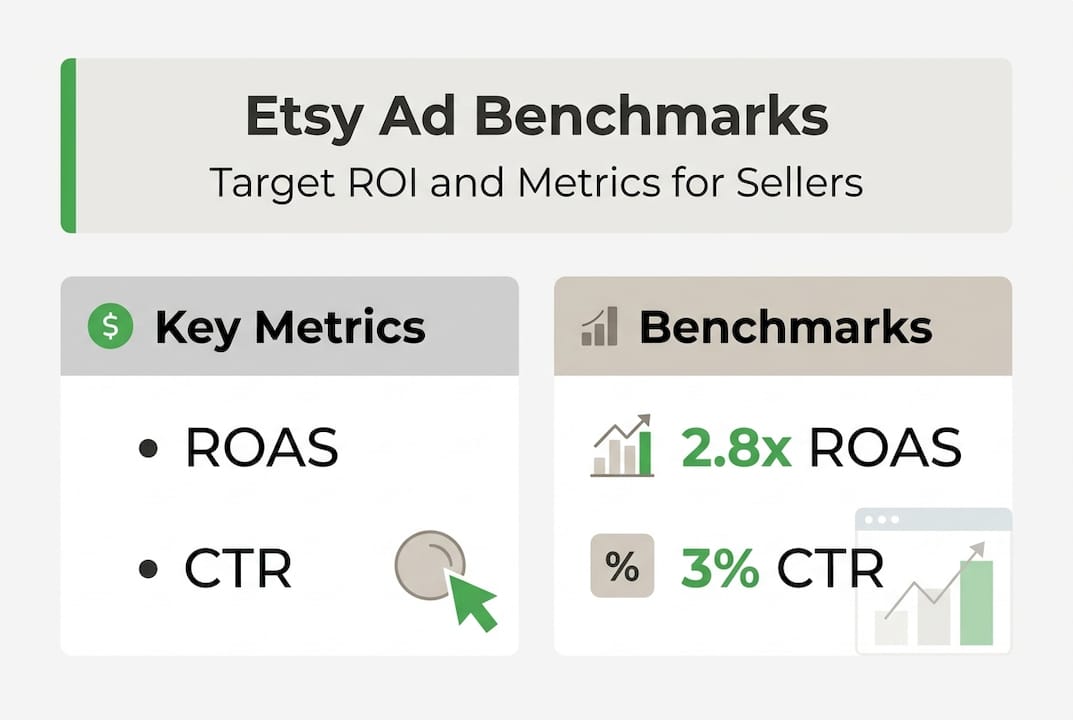
CTR averages between 1% and 3% across most Etsy categories, with 3% or above considered excellent. If your CTR falls below 1%, your main photo or title needs attention before increasing spend.
For break-even ROAS math, always run the numbers against your actual cost of goods and fees, not just your selling price.
Scaling steps based on performance data:
- Confirm a listing has hit at least 3x ROAS over 30 days before scaling.
- Increase daily budget by 20% increments, not in large jumps.
- Monitor for three to five days after each budget increase to detect any performance drop.
- Once a listing consistently hits your target ROAS, add it to your permanent ad roster.
- Reinvest savings from paused underperformers into your top converters.
| Scaling approach | Method | Best for | |---|---|---| | Incremental scaling | +20% budget every 30 days | Stable, proven listings | | Seasonal scaling | Align with peak traffic periods | Holiday and gift categories | | Portfolio expansion | Add new proven listings quarterly | Shops with 10 or more organic sellers |
Statistic: Aligning ad budgets with seasonal demand periods can boost ROAS by up to 60%, making calendar awareness a core part of your 30-day ad strategy.
Our take: What most sellers get wrong and what really works
Here's the uncomfortable truth most ad guides skip: ads don't fix broken listings. If a product isn't converting organically, paid traffic will only make the losses faster. Ads amplify proven listings, not struggling ones. That means your first investment should always be in listing quality, SEO, photography, and pricing.
Break-even ROAS is entirely margin-dependent. Sellers who compare their 2.8x ROAS against a generic benchmark and call it success may actually be losing money. You need to calculate your own number, every time, for every product.
The sellers who consistently win with Etsy Ads follow iterative cycles: test a small budget, prune what doesn't convert, scale what does. Set-and-forget approaches almost always lead to budget drain. Pairing ad runs with ongoing SEO improvements accelerates results because better-optimized listings earn lower CPCs and higher placement in the auction. That combination is where real growth happens.
Unlock smarter Etsy advertising with IndiePixel
Ready to turn these techniques into real-world results? Here's how IndiePixel can amplify your Etsy ad strategy.
Etsy's native stats only show you part of the picture. IndiePixel's Etsy ad tracking tool connects your ad spend across Facebook, TikTok, and Google directly to actual sales, so you know exactly which campaigns drive revenue. No more guessing which platform is working.
Before you increase your budget on any listing, use the cart checker for Etsy to validate that your highest-traffic products are actually purchasable and properly attributed. IndiePixel gives you the attribution clarity and conversion data you need to spend smarter, scale faster, and grow your Etsy business with confidence.
Frequently asked questions
What metrics matter most in Etsy Ads for ROI?
ROAS, CTR, and conversion rate are the core metrics for measuring ad profitability, with ROAS serving as the primary indicator of whether your spend is generating returns above your costs.
How much should a new Etsy shop budget for ads?
New shops should budget $25 to $50 per month, equivalent to roughly 5% to 10% of revenue, and focus spend on three to five listings that already convert organically.
Can ads boost organic sales on Etsy?
Yes, ad-driven sales increase your sales velocity, which can improve your organic search ranking over time, but this effect only holds if your listing quality is strong enough to convert paid traffic in the first place.
What's a break-even ROAS for Etsy Ads?
Your break-even ROAS equals 1 divided by your profit margin percentage. For a 30% margin, that's 3.33x, meaning every dollar in ad spend must return at least $3.33 in revenue just to cover costs.