Step-by-step Etsy attribution guide to maximize ad ROI
Master step by step Etsy attribution to boost your ad ROI. Discover how to connect your ad spend to actual sales and unlock profits!

You're spending real money on Etsy Offsite Ads, running Facebook campaigns, maybe testing TikTok. But when you check your stats, you can't tell which dollars drove which sales. That gap between ad spend and confirmed revenue is where profit disappears, and it's one of the most common frustrations for Etsy sellers running paid campaigns. This guide breaks down exactly how Etsy attribution works, walks you through the step-by-step process for both onsite and offsite channels, and shows you how to measure external ad performance even without direct pixel access, so every budget decision you make is backed by real data.
Table of Contents
- What you need for accurate Etsy ad attribution
- Step-by-step: Attributing sales for Etsy Onsite and Offsite Ads
- Attributing sales from external ads: Manual method for Meta, TikTok, Google
- Troubleshooting, advanced nuances, and common mistakes
- Why perfect attribution is a myth: What matters most for Etsy sellers
- A quicker way to track Etsy attribution and boost your ROI
- Frequently asked questions
Key Takeaways
| Point | Details | | --- | --- | | Know attribution windows | Etsy Offsite Ads use a 30-day last-click window that can impact which sales get reported to ads. | | Use manual tracking for external ads | You must match order and traffic data by timestamp to estimate the ROI of outside ad platforms like Facebook or Google. | | Benchmark with ROAS | Healthy Etsy ad campaigns should target a 3-5x return on ad spend to justify continued investment. | | Accept 'good enough' attribution | Pixel-perfect tracking isn't possible on Etsy so actionable trends and rough alignment are more valuable than chasing exact numbers. |
What you need for accurate Etsy ad attribution
With the challenge clear, let's review what you need and define key concepts so you can attribute sales accurately.
Key terms explained
Attribution is the process of crediting a sale to the specific ad or marketing touchpoint that led to it. On Etsy, three ad types matter:
- Etsy Onsite Ads (also called Etsy Ads): Cost-per-click (CPC) ads that appear within Etsy search results and category pages. You set a daily budget, and Etsy decides which of your listings to promote.
- Etsy Offsite Ads: Etsy places your listings on external platforms like Google Shopping, Facebook, and Pinterest, then charges you a fee (12% to 15%) only when a sale results. Sellers above $10,000 in annual revenue cannot opt out.
- External ads: Campaigns you run independently on Meta, TikTok, Google Ads, or Pinterest, linking directly to your Etsy shop or listings.
Each channel has different tracking capabilities. Understanding the Etsy attribution windows for each is essential before you start comparing numbers.
The 30-day attribution window
The most misunderstood rule in Etsy advertising is how Offsite Ads track sales. Etsy Offsite Ads use a 30-day last-click window: if a buyer clicks an Offsite Ad and purchases anything from your shop within 30 days, that sale is attributed to the ad, even if they buy a completely different item or return through a direct search. This broad window inflates attributed revenue and can make your Offsite Ads appear more profitable than they actually are.

Required data sources
To attribute sales accurately across all channels, you need three primary data sources:
| Data source | What it tracks | Key limitation | |---|---|---| | Etsy Stats > Marketing | Onsite and Offsite Ad attributed sales, clicks, ROAS | No external ad data; 30-day window inflates Offsite numbers | | Google Analytics (GA4) | Traffic sources, sessions, landing pages from external ads | Cannot see completed Etsy checkouts or order values | | Etsy order export (CSV) | Actual order timestamps, amounts, items, buyer details | No direct link to ad source without manual cross-matching |
Keeping all three sources updated and exported regularly is non-negotiable for accurate reconciliation.
Common setup mistakes to avoid
- Not recording ad spend change dates: If you increase your Onsite Ads budget mid-month, your ROAS data gets muddied unless you note exactly when the change happened.
- Assuming all Offsite Ad revenue is incremental: Because of the 30-day window, some of those buyers would have purchased anyway.
- Ignoring the attribution overlap: A buyer might click an Offsite Ad, then later click an Onsite Ad. Etsy uses last-click, so the more recent touchpoint gets credit.
- Not exporting order data consistently: Irregular exports make timestamp matching unreliable for external ad analysis.
These mistakes apply equally to ad optimization tips across all your paid channels.
Pro Tip: Always record the date and time of any ad spend change, budget adjustment, or campaign pause before you run an attribution analysis. Attribution numbers shift over the following 30 days based on that specific change date.
Step-by-step: Attributing sales for Etsy Onsite and Offsite Ads
Armed with your data sources, let's walk through the official Etsy attribution process for onsite and offsite ads, step by step.
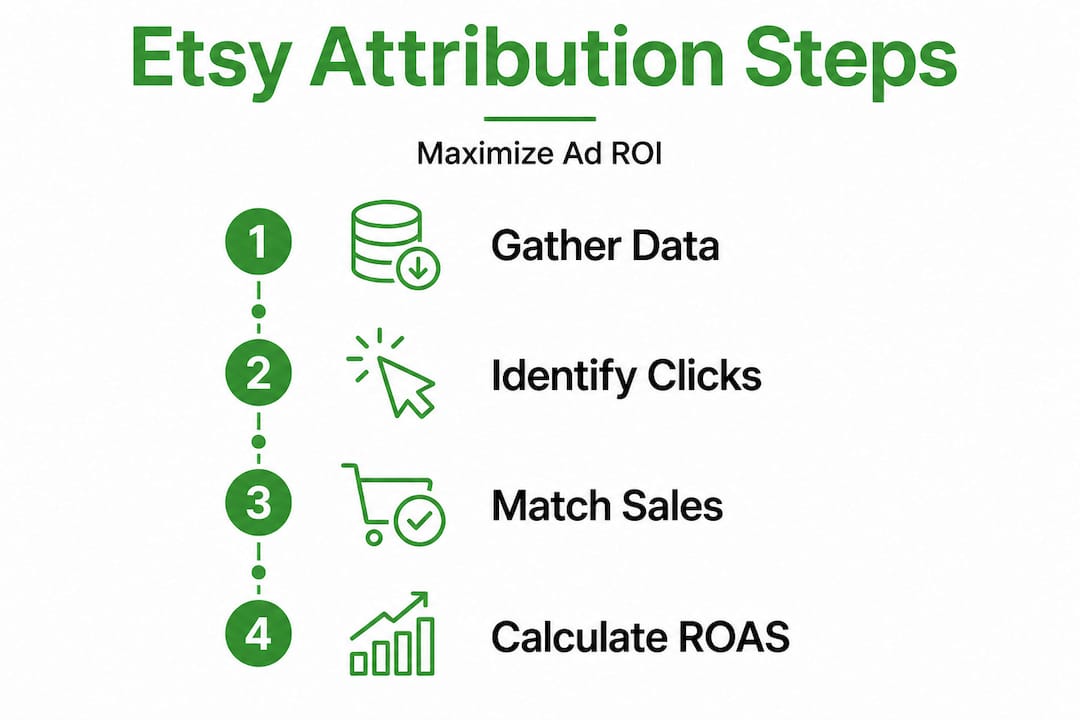
Attributing Onsite Ad sales
Etsy tracks Onsite Ad sales via ROAS: revenue from attributed sales divided by total ad spend, visible inside Stats > Marketing. Etsy's benchmark recommendation is a target of 3 to 5x ROAS for a healthy campaign.
Step-by-step process for Onsite Ads:
- Go to Shop Manager > Marketing > Etsy Ads.
- Select your desired date range. Use at least a 30-day window to get statistically meaningful data.
- Review the Revenue column alongside Ad Spend. This is your attributed revenue.
- Calculate ROAS: divide attributed revenue by ad spend. A $500 revenue result on $100 spend equals 5x ROAS.
- Check the Listing Performance breakdown to identify which specific listings are driving attributed sales.
- Pause or reduce budget on listings with ROAS below 2x and test increasing budgets on listings at 5x or above.
- Review the Click-through Rate (CTR) per listing. Low CTR with high spend means your listing images or titles need work before more budget helps.
Attributing Offsite Ad sales
Offsite Ad attribution follows the same Stats > Marketing path but with a critical caveat. The 30-day attribution tail means that if you opt out of Offsite Ads today, sales from buyers who clicked those ads up to 30 days ago can still be charged the Offsite Ad fee. There is also a 3-day processing lag before opt-out takes effect.
| Ad channel | Attribution window | What counts as an attributed sale | |---|---|---| | Etsy Onsite Ads | Click-level, real-time | Sale on the specific promoted listing after clicking the ad | | Etsy Offsite Ads | 30 days post-click | Any sale from the same shop within 30 days of clicking any Offsite Ad | | External ads (Meta, TikTok, Google) | Platform-dependent | Approximated via traffic and timestamp matching |
Step-by-step process for Offsite Ads:
- Navigate to Shop Manager > Marketing > Offsite Ads.
- Review the Orders attributed and Fees charged figures.
- Compare the fee total against your gross margin on those orders. If Offsite Ad fees regularly exceed 20% of your product margin, the channel is shrinking profitability.
- Export the attributed order data by downloading your Stats CSV file.
- Cross-reference attributed order timestamps with your order history to confirm they align.
- Use your ROAS break-even math to determine the minimum product price at which Offsite Ads remain profitable.
- If you are considering opting out, check your offsite ad opt-out rules before taking action to avoid surprise charges.
Pro Tip: Always benchmark against a 3 to 5x ROAS target for healthy Etsy Ads campaigns. Anything below 2x warrants immediate investigation. Anything above 7x might suggest you are under-spending and could scale profitably.
Attributing sales from external ads: Manual method for Meta, TikTok, Google
Etsy's dashboard gives you solid attribution for on-platform ads, but what about Facebook, TikTok, or Google ad campaigns you run yourself?
Why pixel tracking doesn't work on Etsy
When you run external ads, you normally install a tracking pixel on your website checkout page to capture purchase events. Etsy controls the checkout, and they do not allow third-party pixels on that page. This means no direct pixel tracking is possible for Meta, TikTok, or Google campaigns linking to your Etsy store. The result is that your ad platform dashboards show clicks and sessions but cannot confirm actual purchases.
Manual attribution method for external ads
This process lets you approximate which external ad campaigns drove sales using external ad tracking through cross-channel data matching.
- Set up UTM parameters on all external ad links. At minimum, include utm_source, utm_medium, and utm_campaign so Google Analytics separates your Facebook traffic from your TikTok traffic.
- Open Google Analytics 4 > Reports > Acquisition > Traffic Acquisition. Filter by your campaign UTM values to see session counts and landing page data for each ad campaign during a specific period.
- Export your Etsy order history CSV for the same time period from Shop Manager > Orders.
- Note the timestamps of spikes in external ad traffic from your Google Analytics data.
- Cross-reference those traffic spikes with Etsy order timestamps. If your Facebook campaign drove 300 sessions on Tuesday and you received 12 orders that same day (compared to a daily average of 4), you have a strong signal that the campaign contributed roughly 8 incremental sales.
- Estimate revenue per campaign using the average order value from your Etsy export multiplied by the incremental orders you identified.
- Divide that estimated revenue by your campaign spend to get an approximate ROI for that external campaign.
Best practices for external attribution accuracy
- Run one external campaign at a time when starting out so you isolate traffic sources cleanly.
- Compare a 7-day window before and after launching a campaign to establish a reliable baseline order rate.
- Use consistent UTM naming conventions across all campaigns so your Analytics data stays clean and sortable.
- Export both your traffic data and order data on the same day each week to prevent gaps.
- Track cart adds in addition to orders. Even if a session doesn't convert immediately, a cart add is a purchase signal worth noting for Etsy analytics for ROI purposes.
Warning: Multi-device user journeys make manual attribution inherently approximate. A buyer might see your TikTok ad on their phone, browse on a tablet, and purchase on a desktop later that evening. Your traffic data will show three separate sessions from different sources. Never treat manual attribution numbers as exact figures. Use them as directional signals to rank campaign performance, not as precise sales counts.
Troubleshooting, advanced nuances, and common mistakes
After following the steps, here's how to check for errors, recognize nuances, and solve attribution puzzles Etsy sellers frequently encounter.
Common attribution mistakes and how to fix them
- Mistake: Comparing different date ranges across tools. Fix: Always export data from GA4 and Etsy Stats using the exact same start and end dates.
- Mistake: Ignoring returning buyers in Offsite Ad attribution. Fix: Understand that a loyal customer who clicks an Offsite Ad and reorders will still be attributed to that ad, inflating your Offsite ROAS.
- Mistake: Not accounting for seasonal baseline shifts. Fix: Compare your campaign period against the same period from the prior year, not just the prior week.
- Mistake: Treating Onsite and Offsite ROAS as comparable metrics. Fix: Because their attribution windows and mechanics differ, analyze them separately with different performance benchmarks.
- Mistake: Pausing campaigns mid-attribution window. Fix: If you pause a campaign, note the date carefully. Attributed sales from the preceding 30 days may continue to be credited, which can make paused campaigns appear artificially profitable in retrospect.
Etsy's machine learning layer
One detail most sellers overlook is that Etsy's Onsite Ad targeting is not purely manual. Etsy uses an ADPM machine learning module that predicts click-through rates and conversion rates based on real-time user behavior within the past hour. This means two sellers running identical listings with identical budgets can see different attribution outcomes depending on who is searching at any given time. Your listed ad budget is not the only factor determining which listings get promoted.
This machine learning layer is also why ad performance can fluctuate week to week without any action on your part. If Etsy's algorithm shifts which buyer segments it targets with your listings, your attributed revenue changes regardless of your settings.
Revisiting old ad spend
One overlooked attribution trap is the trailing 30-day window. If you ran a major campaign in the first week of the month and then reduced your budget, keep checking your attributed sales figures for the full 30 days following that campaign. Sales will continue to appear in your Stats > Marketing view as buyers who clicked early return and purchase later. Use Etsy ad best practices to factor this delay into your monthly reporting cycles.
Why perfect attribution is a myth: What matters most for Etsy sellers
Now that you've seen the technical how-to, let's zoom out and share some hard-won perspective from working with real Etsy seller data.
Pixel-perfect attribution is not achievable on Etsy. It is not even achievable on fully self-hosted ecommerce stores with complete tracking control. Multi-device journeys, private browsing, ad blockers, and Etsy's own platform restrictions make 100% accuracy a moving target that you should not be chasing.
The sellers who improve their ROI fastest are not the ones who wait for perfect data. They are the ones who act on clear directional signals. If an Onsite Ads listing is consistently delivering 6x ROAS over three consecutive months while another listing sits at 1.5x, you have enough information to reallocate budget. You do not need to validate every single attributed sale to make that call.
The contrarian point worth making here is that over-analyzing attribution discrepancies is often a productivity trap. Spending three hours reconciling a $40 variance between your Etsy Stats and your GA4 traffic report is not a valuable use of your time. Knowing when to pause unprofitable ads based on clear trend data, and acting quickly, produces more revenue improvement than chasing precision.
Consistency matters more than perfection. Use the same measurement methodology every month, track ROAS trends over time, and make incremental adjustments based on consistent signals. Sellers who adopt that discipline, even with imperfect data, reliably outperform those who are paralyzed waiting for flawless numbers.
The uncomfortable truth is that attribution will always have gaps on Etsy. Your competitive advantage comes from having a structured, repeatable process that reduces the guesswork enough to make confident, profitable decisions.
A quicker way to track Etsy attribution and boost your ROI
Ready to streamline your attribution process and see results more simply?
Manual attribution gives you a solid foundation, but it is time-consuming, and the data gaps compound as you run more campaigns simultaneously. IndiePixel is built specifically to close those gaps for Etsy sellers.

IndiePixel ad tracking automates the process of capturing purchase signals and syncing conversion data back to your ad platforms, so Facebook, TikTok, and Google Ads can see which campaigns actually drove sales. Rather than spending hours cross-matching spreadsheets, you get a unified dashboard that shows attributed revenue per campaign in one place. You can also use IndiePixel's cart checker tool before committing to new ad spend, validating product viability and demand signals before you invest. For sellers running multiple external campaigns, this level of automation removes the guesswork and gives you the data confidence to scale what works.
Frequently asked questions
What is the attribution window for Etsy Offsite Ads?
Etsy Offsite Ads use a 30-day last-click window, meaning any purchase from your shop within 30 days of an ad click is attributed to that ad, regardless of how the buyer returned or what they purchased.
How do I calculate my Etsy Ads ROAS?
Divide your attributed ad revenue by your total ad spend for the same period, and target a result between 3x and 5x for sustainable campaign health.
Can I track sales from Facebook or Google Ads on Etsy?
Direct pixel tracking is not available, but you can approximate conversions by correlating external traffic data from Google Analytics with Etsy order timestamps to estimate campaign-driven sales.
Do sales still get attributed to Offsite Ads after I opt out?
Yes, because of the 30-day attribution tail and the 3-day processing lag, buyers who clicked your Offsite Ads before you opted out can still generate attributed sales and fees for up to 30 days after their click.
Why do my attribution numbers differ across analytics tools?
Different tools measure different touchpoints, and multi-device user journeys often create separate sessions that don't connect cleanly. Use consistent date ranges and treat cross-tool numbers as trend signals rather than exact figures.