Bridge your Etsy ad data for smarter campaign ROI
Discover why bridge Etsy ad data for smarter ad spend decisions! Gain clarity on your ad performance and maximize your campaign ROI today.

Running ads on Facebook, TikTok, or Google while selling on Etsy puts you in a frustrating position. You're spending real money every day, but your Etsy dashboard only gives you a partial picture of what's happening. You can see clicks and visits, but you can't clearly see which ad dollars are turning into actual orders. That gap between ad spend and confirmed sales is where budgets get wasted. The good news is that bridging your Etsy ad data closes that gap entirely, giving you the attribution clarity you need to make smarter, faster decisions with your ad budget.
Table of Contents
- Understanding the limitations of native Etsy ad analytics
- What it means to bridge Etsy ad data
- How bridging ad data improves Etsy campaign effectiveness
- Steps to start bridging your Etsy ad data
- Why most Etsy sellers overlook data bridging (and why you shouldn't)
- Ready to take control of your Etsy ad data?
- Frequently asked questions
Key Takeaways
| Point | Details | | --- | --- | | Native analytics miss conversions | Etsy’s built-in tools often fail to show which ads actually lead to sales across different platforms. | | Bridging unlocks true ROI | Connecting ad data across channels gives clear, actionable insights that let you spend smarter. | | Practical steps make it doable | With the right roadmap and tools, any seller can start bridging their ad data for immediate improvements. | | Advanced sellers gain a competitive edge | Sellers who bridge their ad data optimize faster, reduce waste, and outperform those who rely on guesswork. |
Understanding the limitations of native Etsy ad analytics
Every Etsy seller eventually runs into the same wall. You log into your dashboard, check your stats, and see traffic numbers. What you don't see is a clear line connecting a specific Facebook campaign or a TikTok video ad to a completed purchase. That missing line is attribution, and without it, you're making budget decisions based on incomplete information.
Native Etsy reporting often lacks detailed attribution for sales that originate from external advertising sources. This is a structural limitation, not something you can fix by digging deeper into the existing dashboard settings. Etsy's platform is built to show you activity inside the Etsy ecosystem, not to track the full journey a buyer takes before landing on your shop.
Here's what that looks like in practice. A shopper sees your promoted post on Facebook on Monday, doesn't buy, comes back through a TikTok ad on Thursday, and finally purchases after searching Etsy directly on Friday. Etsy's analytics would likely credit that sale to organic search. Your Facebook and TikTok campaigns both played a role, but neither gets proper credit. This is called multi-touch attribution failure, and it directly inflates your costs when you pull back on campaigns that are actually contributing to sales.
The specific gaps in native Etsy analytics include:
- No cross-platform conversion tracking: Etsy doesn't connect purchase data to Facebook Ads Manager, Google Ads, or TikTok Ads natively.
- No customer journey mapping: You can't see the sequence of touchpoints a buyer went through before converting.
- Limited campaign-level data: Knowing your total traffic is useful, but it doesn't tell you which specific ad creative or audience drove results.
- No post-click behavior tracking: Etsy doesn't report on how long a visitor stayed, how many listings they viewed, or what made them leave without purchasing.
"Without proper attribution, ad spend decisions become guesswork. Sellers end up cutting campaigns that were quietly contributing to sales while doubling down on campaigns that look impressive but don't convert."
Understanding the full picture of tracking Etsy ad KPIs is the first step toward better decision making. You also need to understand the basics of the Etsy ad placement process to know where your spend is going before you can meaningfully evaluate results.
The core issue is not that Etsy's analytics are poorly built. They're designed for a specific purpose. The problem arises when sellers try to run sophisticated multi-channel ad campaigns and expect Etsy's native tools to keep up. They can't. That's when supplemental data bridging becomes essential.
What it means to bridge Etsy ad data
Bridging ad data is the process of connecting your ad platforms (Facebook, TikTok, Google) with your Etsy shop activity so that you can see a unified view of every customer's journey from first click to final purchase. Instead of reading three separate dashboards and guessing how they relate to each other, you get a single, accurate picture of which campaigns are actually working.

Bridging ad data enables sellers to attribute conversions to the correct ad campaign, even when customers cross between platforms before purchasing. This is possible through the use of tracking links with campaign parameters (also known as UTM parameters), conversion APIs, and tools that capture purchase events and send that data back to the relevant ad platforms.
Here's a simplified breakdown of how bridging works in practice:
| Step | What happens | Why it matters | |---|---|---| | A shopper clicks your ad | A tracking parameter is attached to the visit | Identifies which campaign sent the visitor | | The shopper visits your Etsy listing | The tracking tool records the session data | Creates a data point in the attribution chain | | The shopper makes a purchase | The purchase event is captured | Links the sale to the original ad campaign | | Data is sent to your ad platform | Facebook, TikTok, or Google receives the conversion signal | Allows the platform to optimize future ad delivery |
The benefit of this system goes beyond just knowing where your sales come from. When your ad platform receives accurate conversion signals, its algorithm can find more shoppers who match the profile of people who actually bought from you, not just people who clicked. This improves your ad targeting over time, which reduces your cost per acquisition.
Pro Tip: Even if you're only running ads on one platform right now, setting up proper bridging early means you'll have clean, comparable data when you expand to a second channel. Starting without it means you'll have gaps in your historical data later.
The real-world impact is straightforward. A seller running tracking Etsy conversions across platforms with bridged data can answer specific questions: Which campaign had the lowest cost per sale? Which audience segment converted best? Did the holiday discount ad outperform the new product launch ad? These questions are unanswerable without bridging. With it, they become routine.
Looking deeper into Etsy ad data analytics shows that sellers who bridge their data can also build better audience segments, run more effective retargeting campaigns, and reduce the amount of budget wasted on clicks that never convert.
How bridging ad data improves Etsy campaign effectiveness
Once your ad data is properly bridged, the practical benefits show up quickly and in very concrete ways. This isn't about having fancier reports. It's about making decisions that directly affect your revenue and ad efficiency.
Sellers that bridge their Etsy ad data see a measurable improvement in campaign ROI by allocating budget toward the channels that actually convert. The mechanism is simple: when you know which ads convert and which ones don't, you stop funding the underperformers.
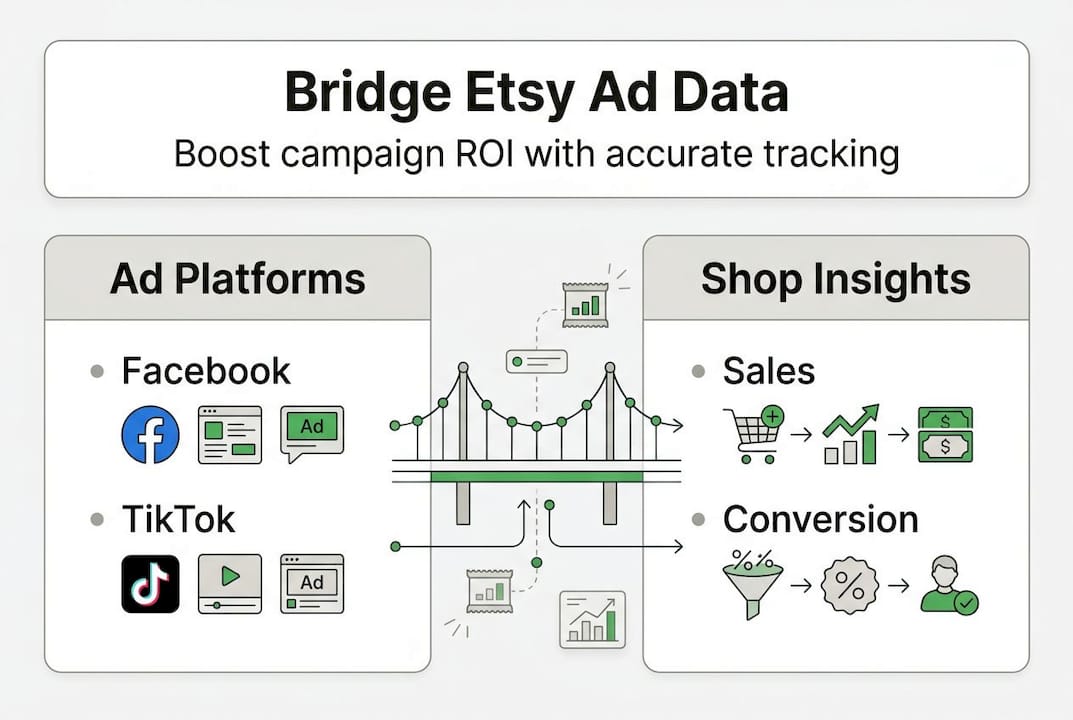
Consider this realistic scenario. A seller runs simultaneous campaigns on TikTok and Facebook for a handmade jewelry product. Without bridging, both platforms report hundreds of clicks and the seller assumes both are working. With bridging, the data reveals that TikTok drives traffic but Facebook closes sales. The seller shifts 70% of the budget to Facebook, and cost per sale drops significantly within two weeks.
Here's a direct comparison of what managing ads looks like with and without bridged data:
| Ad management factor | Without bridging | With bridging | |---|---|---| | Attribution accuracy | Partial or none | Full, cross-platform | | Budget decisions | Based on clicks/traffic | Based on actual conversions | | Campaign optimization | Slow and reactive | Fast and data-driven | | Retargeting quality | Low, no conversion signals | High, based on buyers | | Time spent on reporting | High (manual reconciliation) | Low (automated, unified) |
The improvements you'll notice include:
- Accurate cost per sale: You can calculate exactly how much each platform charges you per confirmed order, not per click.
- Better creative testing: When you know which ad creative leads to purchases, you can confidently scale the winners and retire the losers.
- Smarter audience building: Ad platforms use conversion signals to find lookalike audiences. Better signals produce better lookalikes.
- Faster iteration cycles: With real data available quickly, you can test and adjust campaigns in days rather than weeks.
Understanding improving Etsy ad return through attribution data also changes how you think about ad copy and targeting. Instead of guessing what your customers respond to, you let conversion data tell you. Tracking your crucial Etsy ad KPIs becomes significantly more meaningful when the underlying data is accurate.
For sellers ready to go further, advanced Etsy ad strategies built on bridged data open up possibilities like sequential messaging, funnel-based bidding, and customer lifetime value targeting.
Steps to start bridging your Etsy ad data
Starting the bridging process doesn't require a technical background. It does require a clear plan and the right tools. Here's a practical roadmap to get you from zero attribution to full data bridging.
-
Audit your current analytics setup. Review what you're currently tracking. Check whether you have any UTM parameters on your ad links, and verify whether your ad platforms are receiving any conversion signals from Etsy at all. Many sellers discover they have no attribution set up whatsoever at this stage.
-
Define your campaign goals. Before adding any tracking, be clear on what a conversion means for your shop. Is it a completed purchase? A listing view? A cart add? For most Etsy sellers focused on sales, a purchase event is the primary conversion to track.
-
Select a tracking tool with cross-platform attribution support. Getting started with Etsy ad data bridging requires a reliable tracking tool that supports attribution across traffic sources. Generic analytics tools often don't cover the specific needs of Etsy sellers, particularly around purchase event capture and conversion API integration.
-
Set up tracking links for each active campaign. Use UTM parameters to tag every ad link with the platform, campaign name, and ad set. This creates identifiable data points that can be traced from click to purchase without guessing.
-
Connect your conversion API. This step sends purchase event data directly from your shop back to the ad platforms. This is especially important after browser privacy changes reduced the reliability of pixel-based tracking. A conversion API sends data server-side, making it more accurate and privacy-compliant.
-
Verify your data connections before scaling spend. Don't increase your ad budget until you've confirmed that purchase events are being correctly recorded and attributed. Run a small test, make a test purchase if possible, and check that the event appears in your ad platform's event manager.
-
Review and reconcile data weekly. Compare your Etsy orders against your attributed conversions in your tracking tool. This reconciliation step catches discrepancies early and keeps your optimization decisions grounded in accurate numbers.
Pro Tip: Use a 30-day playbook approach to your first month of bridged data tracking. Treat weeks one and two as your setup and verification phase, and weeks three and four as your first active optimization window. This structure prevents you from making budget changes before you have enough reliable data.
Common mistakes to avoid when bridging your data:
- Skipping verification: Assuming your tracking setup works without testing it leads to missing data and wrong conclusions.
- Using inconsistent UTM naming conventions: If you label the same campaign differently across platforms, you won't be able to aggregate data cleanly.
- Ignoring view-through attribution: Some purchases are influenced by ad views, not just clicks. Check whether your tracking tool captures this.
- Mixing up correlation and causation: More traffic from a platform doesn't mean that platform is converting. Always check conversion rates alongside volume.
Why most Etsy sellers overlook data bridging (and why you shouldn't)
Most sellers don't bridge their ad data because it feels like extra work on top of an already demanding business. That reasoning is understandable. It is extra work, at least initially. But the sellers who skip this step don't avoid the problem. They just absorb it silently through wasted ad spend and missed optimization opportunities.
Here's the uncomfortable reality: your biggest competitors are almost certainly using advanced attribution. They've invested in proven Etsy ad strategies backed by real conversion data, and they're making budget decisions with a precision that's simply not possible without bridging. Every month you operate without proper attribution is a month they're using your ad category's budget more efficiently than you are.
The "ignorance is bliss" mindset actively costs you money. If you don't know which campaign converts, you're likely funding at least one that doesn't. Most sellers who set up bridging for the first time are surprised to find that their assumptions about which platform was performing were wrong. The traffic leader is rarely the conversion leader.
Once you see real attribution data, your relationship with ad spend changes permanently. You stop looking at clicks as a success metric and start evaluating every decision against cost per actual sale. That shift in thinking is worth far more than the time it takes to set up bridging correctly.
Ready to take control of your Etsy ad data?
You now understand why native Etsy analytics fall short and what bridging ad data can do for your campaign results. The next step is putting the right tools in place so this process runs automatically, without manual spreadsheet work or platform-hopping.
IndiePixel is built specifically for Etsy sellers who want accurate attribution across Facebook, TikTok, and Google Ads. It automates purchase signal capture, sends data to your ad platforms through conversion APIs, and organizes everything in a unified dashboard. You can also use the Etsy cart checker tool to validate potential ad spend before you commit, so you're making decisions based on real demand signals. Explore Etsy ad tracking automation and see how quickly accurate data changes the way you manage your campaigns.
Frequently asked questions
What does it mean to bridge ad data for Etsy?
Bridging ad data means connecting multiple ad platforms with your Etsy shop analytics to accurately track which campaigns and channels deliver conversions. This process enables accurate conversion attribution even when customers interact with multiple platforms before purchasing.
Why isn't native Etsy analytics enough for serious sellers?
Etsy's default analytics don't attribute sales across multiple ad channels, leading to missed insights and inefficient ad spend. Native Etsy reporting lacks detailed attribution for sales that originate from external advertising sources, which makes cross-platform campaign evaluation essentially impossible.
How does bridging help improve Etsy ad ROI?
It clarifies which ads actually convert, so you can cut underperforming campaigns and focus your budget on what delivers real results. Sellers who implement bridging see measurable ROI improvement by directing budget toward channels with confirmed conversions rather than just traffic.
What's the first step to start bridging Etsy ad data?
Begin by reviewing your current analytics tools and consider implementing a platform that offers advanced attribution across channels, like IndiePixel. Effective bridging requires a reliable tracking tool that supports attribution across all your active traffic sources from day one.