How to attribute Etsy sales to ads and boost ROI
Discover how to attribute Etsy sales to ads and boost ROI with our essential guide. Implement effective tracking for better insights!

Running ads for your Etsy shop without reliable attribution data is like spending money in the dark. You see clicks, you see some sales, but you cannot confidently say which campaign, which ad set, or which platform actually drove those purchases. This problem costs Etsy sellers real money every month. When you cannot connect your ad spend to specific sales, you end up funding campaigns that underperform and cutting ones that actually work. This guide covers exactly how attribution works on Etsy, what tools you need, and how to implement a practical tracking system that gives you actionable answers instead of guesses.
Table of Contents
- What is Etsy sales attribution?
- Core tools and methods to attribute sales
- Step-by-step: How to attribute sales from Etsy and external ads
- Common pitfalls and troubleshooting your attribution
- Why most Etsy attribution advice doesn't address the real challenge
- Level up your tracking with IndiePixel
- Frequently asked questions
Key Takeaways
| Point | Details | | --- | --- | | Shop Stats empower insight | Etsy Shop Stats and Ads dashboards let you see sales attribution by traffic source for smarter decision-making. | | External ads need manual tracking | Use UTMs, unique coupons, and sales trends to connect Facebook or TikTok ad spend to Etsy sales. | | Cross-check for accuracy | Layering native and manual tracking methods avoids attribution blindspots and improves ROI. | | Optimize with ROAS | Calculating return on ad spend using Etsy's metrics helps you know when to pause or scale ads. |
What is Etsy sales attribution?
Attribution, in the context of advertising, means connecting a sale to the specific marketing action that influenced it. That action could be a paid ad click, an organic search result, a social media visit, or a direct link someone typed into their browser. On Etsy, attribution tells you which of these sources is actually responsible for your orders and revenue.
Etsy provides some built-in visibility through Shop Stats. The platform breaks down traffic sources including Etsy search, Etsy Ads, social referrals, and direct visits, and lets you compare visits, orders, and revenue by source over periods of 30 days or more. This gives you a starting point for understanding which channels are pulling their weight.
Here is why accurate attribution matters so much:
- Budget decisions: If you know Facebook Ads drives twice the revenue per dollar compared to Etsy Ads, you can shift budget accordingly.
- Ad optimization: Attribution data tells ad platforms like Meta or TikTok which users converted, allowing their algorithms to find more similar buyers.
- Profitability analysis: Revenue figures alone do not tell the full story. Connecting ad spend to attributed sales lets you calculate true return on ad spend (ROAS) and protect your margins.
- Scaling with confidence: Without attribution, scaling your ad spend is a risk. With it, you know which levers actually move the needle.
The catch is that Etsy's default attribution is imperfect. When a customer clicks multiple ads or visits your shop several times before buying, Etsy's system may credit only one touchpoint. This single-touch attribution model can skew your understanding of what is actually driving sales, especially if you run both Etsy Ads and external campaigns simultaneously. You can learn more about how these time windows affect your data in this Etsy attribution windows guide.
Key insight: Etsy attributes a sale to the last ad interaction within a set window. If a shopper clicked your Facebook Ad three days ago and then found you through Etsy search today, Etsy credits the search, not the Facebook campaign that initially brought them to your shop.
Pro Tip: Always look at attribution data over a minimum of 30 days. Shorter windows can produce misleading spikes or dips that do not reflect your actual campaign performance patterns.
Core tools and methods to attribute sales
Once you understand what attribution means, the next step is knowing which tools and methods to use. The right combination depends on whether you are running Etsy Ads, external ads, or both.
Etsy-native tools
Etsy Ads dashboard: This is your primary source for on-platform attribution. It shows attributed sales, clicks, impressions, spend, and ROAS for your promoted listings. ROAS is calculated as revenue from attributed ad sales divided by ad spend, and Etsy provides this figure directly in the dashboard. A ROAS of 3.0, for example, means you earned three dollars in attributed revenue for every dollar spent. You can find a detailed breakdown of how to use this number in this Etsy Ads ROAS break-even math resource.
Shop Stats: Useful for comparing traffic sources over time. You can see not just which channel sends the most visitors, but which channel converts those visitors into buyers.
External ad tracking tools
When you run ads on Facebook, Instagram, TikTok, Pinterest, or Google, Etsy does not natively connect that spend to your sales. You need additional methods. Here is a comparison of the main options:

| Method | Effort Level | Accuracy | Best For | |---|---|---|---| | UTM parameters | Low to medium | Medium | All external traffic sources | | Unique coupon codes | Medium | Medium to high | Direct response campaigns | | Time correlation analysis | Medium | Low to medium | Confirming channel impact | | Third-party attribution tools | Low (after setup) | High | Sellers scaling ad spend | | Manual spreadsheet reconciliation | High | Variable | Low-budget starting point |
For a deep dive into setting up each of these, the guide on how to track conversions for Etsy external ads walks through each method with specific instructions.
UTM parameters are tags you add to the end of your Etsy listing URLs. They carry information about the source (Facebook), medium (paid social), and campaign name (summer-collection). When someone clicks your ad link and lands on Etsy, Shop Stats picks up that UTM data and logs it as a referral visit. The Etsy UTM tracking guide covers the exact syntax and setup process.
Unique coupon codes give you a direct signal. Assign one code per campaign, for example TIKTOK10 for a TikTok campaign. When buyers redeem that code, you know which platform sourced that sale. This method works well alongside UTMs for double verification.
Pro Tip: Use a consistent naming convention for both UTM parameters and coupon codes. Something like "platform_campaign_month` makes your data far easier to analyze across multiple campaigns and months.
Step-by-step: How to attribute sales from Etsy and external ads
Here is a practical process you can follow to build a working attribution system for both Etsy Ads and external traffic sources.
-
Identify your ad sources. List every channel where you run or plan to run ads. This might include Etsy Ads, Facebook, Instagram, TikTok, Pinterest, or Google Shopping. Each source needs its own tracking approach.
-
Configure tracking for each source. For Etsy Ads, the dashboard handles this automatically. For external ads, build UTM-tagged links for every campaign and ad set. Simultaneously, create a unique coupon code for each active external campaign and include it in your ad creative or caption.
-
Monitor stats consistently. Check Shop Stats weekly to see referral traffic broken down by source. Review coupon code redemptions in your Etsy order data. Cross-reference visit spikes with your active campaign periods.
-
Analyze results at the campaign level. Do not just look at total sales. Break down results by source, campaign, and time period. Calculate the cost per order for each channel by dividing your ad spend by the number of attributed or coupon-verified sales.
-
Optimize based on data. Pause or adjust campaigns that show a high cost per order relative to your product margins. Scale up budget for campaigns with strong attribution signals and profitable ROAS figures.
One important note about external platforms: no direct pixel tracking exists for Meta or TikTok ads pointing to Etsy. You cannot install a Facebook Pixel or TikTok Pixel on Etsy product pages. This is why indirect methods like UTM tags, timing correlation, unique coupons, and ETL (extract, transform, load) data tools are necessary for track Etsy conversions from external ads.
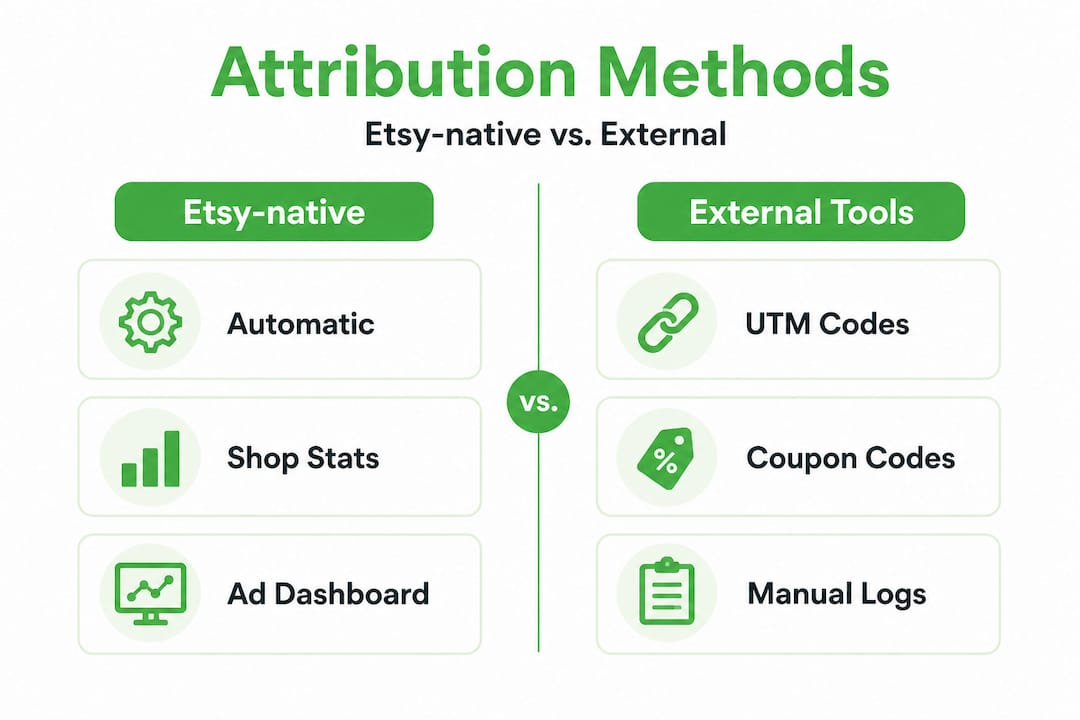
Comparison: Etsy-native vs. external attribution methods
| Factor | Etsy-native attribution | Manual/third-party attribution | |---|---|---| | Setup complexity | None (automatic) | Medium to high | | Covers external ads | No | Yes | | Accuracy | Moderate (last-touch) | Medium to high (method-dependent) | | Ongoing maintenance | Low | Medium | | Actionability for external spend | Low | High |
Pro Tip: Combine UTM data with coupon code redemption rates to get the most complete picture of external ad performance. If UTM data shows 200 visits from a Facebook campaign and you see 15 redemptions of your Facebook-specific coupon, you have two independent signals confirming real purchase activity.
Common pitfalls and troubleshooting your attribution
Even sellers who follow the right steps can end up with unreliable attribution data. These are the most common mistakes and how to fix them.
Pitfalls to watch for:
- Overestimating Etsy's native attribution. Etsy's last-touch model can give too much credit to organic search and too little to the ads that actually introduced a customer to your shop. Do not treat the Ads dashboard as the complete picture.
- Ignoring view-through activity. Not every ad drives an immediate click. Some shoppers see your TikTok ad, remember your product, and search for it on Etsy later. That sale looks organic but was ad-influenced. Coupon codes can help catch some of this.
- Confusing revenue with profit. ROAS measures revenue per dollar spent, not profit. A ROAS of 2.5 on a product with a 30% margin might still be losing money after fees, shipping, and materials.
- Inconsistent coupon naming. Switching coupon code formats mid-campaign makes it impossible to aggregate data cleanly across time periods.
- Spreadsheet overload. Manually tracking multiple campaigns across multiple platforms in spreadsheets is unsustainable. Data entry errors accumulate quickly and lead to bad decisions.
Troubleshooting steps:
- Cross-verify Shop Stats data against your actual order list. Look for orders that arrived during active campaign periods but show as direct or organic traffic.
- Keep a campaign log that records the coupon code, UTM parameters, start date, end date, and spend for every campaign. This makes reconciliation much faster.
- If your external ad platform (Meta, TikTok) shows high traffic but Shop Stats shows low referral visits, check that your UTM links are formatted correctly and not being truncated.
Expert note: Sellers who successfully track external ad performance on Etsy generally use multiple tracking methods in combination rather than relying on any single tool. Those who depend solely on Etsy's native data often underestimate which external channels contribute to sales. Understanding Etsy Offsite Ads and fees is also part of getting a complete profitability picture, since those fees affect your margin calculations.
Why most Etsy attribution advice doesn't address the real challenge
Most articles on Etsy attribution stop at "use UTMs and check your Shop Stats." That advice is not wrong, but it is incomplete. The real challenge for Etsy sellers running external ads is that the data gap between ad platforms and Etsy's backend is significant, and bridging it requires more than tagging a few links.
Here is what experienced sellers know that most how-to guides skip: Etsy's platform was not designed with multi-channel attribution in mind. Shop Stats gives you useful data for understanding organic traffic. It was never built to serve as a conversion tracking system for paid social or search campaigns. Treating it like one leads to systematic underreporting of external ad value.
Pro sellers do not rely on one attribution signal. They cross-check Etsy dashboard data against UTM referral reports, coupon redemption records, and sometimes order timestamps aligned to campaign run times. That triangulation takes work, but it produces much more accurate conclusions about what is actually driving revenue.
The other piece most guides miss is the importance of building your tracking infrastructure before you scale spend. Sellers who start running heavy Meta or TikTok budgets without a solid attribution setup in place are essentially flying blind. By the time they realize they cannot attribute their sales accurately, they have already wasted a significant portion of their budget. Setting up ecommerce analytics to boost Etsy ad ROI before scaling is the move that separates disciplined sellers from those constantly chasing their tails.
Manual reconciliation is not glamorous. But actionable attribution means putting in the work, or having a tool that automates it for you. The sellers who get this right consistently outperform those who rely on gut instinct or platform-level estimates.
Level up your tracking with IndiePixel
Etsy sellers serious about ad performance need more than Etsy's built-in reporting. The methods in this guide work, but they take time to set up and maintain manually.
IndiePixel is built specifically to close that gap. It captures purchase signals from your Etsy store and sends accurate conversion data back to your ad platforms, including Facebook, TikTok, and Google Ads. Instead of piecing together UTM reports and coupon logs, you get a unified dashboard that shows which campaigns are driving actual sales, not just clicks. IndiePixel's Conversion API sync, CSV order upload, and cart checker tools give you the attribution data you need to optimize confidently. If you are ready to stop guessing and start making data-driven decisions, IndiePixel Etsy Ad Tracking is built for exactly that.
Frequently asked questions
How do I see which ad drove an Etsy sale?
You can see attributed sales by traffic source in Etsy's Shop Stats and the Ads dashboard; traffic sources breakdown shows visits, orders, and revenue by channel. External ads require manual tracking methods like UTMs or coupon codes.
Can I track sales from Facebook, Instagram, or TikTok ads on Etsy?
Etsy does not allow pixels, so you need to use UTMs, unique coupon codes, and time-based analysis. No direct pixel tracking exists for Meta or TikTok ads pointing to Etsy listings.
What does "attributed sale" mean in my Etsy Ads dashboard?
An attributed sale is a transaction Etsy links to a specific ad click or view within the attribution window. It is not always a direct click-to-purchase; Etsy tracks visits, orders and assigns credit based on the last qualifying ad interaction.
How do I calculate ROAS for my Etsy ads?
ROAS is your attributed ad revenue divided by your ad spend for the same period. ROAS is provided directly in the Etsy Ads dashboard, so you do not need to calculate it manually for on-platform campaigns.
Why doesn't Etsy's attribution match my outside ads?
Etsy's tools only attribute sales to traffic it can directly observe on its platform. Indirect tracking methods like UTMs and coupon codes are required to connect external ad spend to Etsy orders.