Why Google Ads optimization lifts your Etsy sales
Discover why optimizing Google Ads for handmade can boost your Etsy sales. Unlock higher conversions and maximize your ad spend!

Running Etsy Ads and seeing modest results is a frustration many handmade sellers know well. The reality is that Etsy Ads alone leave significant revenue on the table. Case studies show real gains: a jewelry shop optimized its images and lifted click-through rate by 33% and conversion rate by 89%, while a wholesale jewelry brand scaled from $18,000 to $80,000 per month at 791% return on ad spend using segmented Google Ads campaigns. These are not outliers. They are what happens when you stop relying on a single ad channel and start optimizing Google Ads with intention.
Table of Contents
- Why Etsy sellers need Google Ads optimization
- How optimizing campaigns empowers handmade sellers
- Winning strategies: Campaign structures and smart bidding for handmade
- How to track results and attribute sales accurately
- A realistic perspective: What most Etsy sellers miss about Google Ads
- Take the next step: Make handmade ads work harder for you
- Frequently asked questions
Key Takeaways
| Point | Details | | --- | --- | | Google Ads unlocks control | You get better targeting, keyword choice, and reach than with Etsy Ads alone. | | Optimized feeds boost sales | Structured, high-quality product data directly raises click and conversion rates. | | Track and attribute accurately | Implement enhanced conversions and attribution for clear ROI measurement. | | Segmentation amplifies returns | Target high-margin or best-selling handmade items for stronger results and efficiency. |
Why Etsy sellers need Google Ads optimization
With real outcomes in mind, let's examine why optimizing Google Ads is a game-changer compared to relying only on Etsy's platform.
Etsy Ads are convenient, but they are also limited. You cannot choose your keywords, control your placements, or define your audience with any precision. Etsy's system uses auto-bidding, which means the platform decides how and where your money is spent. For handmade sellers, this is a real problem because buyers searching Google for "handmade ceramic mug" or "custom leather wallet near me" are already expressing strong purchase intent. Google Ads reaches these buyers with keyword control, audience targeting, and placement options that Etsy simply does not offer.
There is also the issue of Etsy's offsite ad program. When Etsy runs ads off-platform on your behalf, it charges a 12% to 15% fee on any resulting sale. You have no visibility into which platforms drove the sale, what the actual cost per acquisition was, or how to replicate the result. This is attribution in the dark. With Google Ads, you own the data.
Here is a direct comparison of the two platforms:
| Feature | Google Ads | Etsy Ads | |---|---|---| | Keyword control | Full control | None | | Audience targeting | Yes (demographics, interests) | None | | Placement control | Yes (Search, Shopping, Display) | Limited | | Bidding strategy | Manual and Smart Bidding | Auto only | | Attribution visibility | Detailed (with setup) | Minimal | | Offsite fee | None | 12 to 15% | | Feed optimization | Required and impactful | Not available |
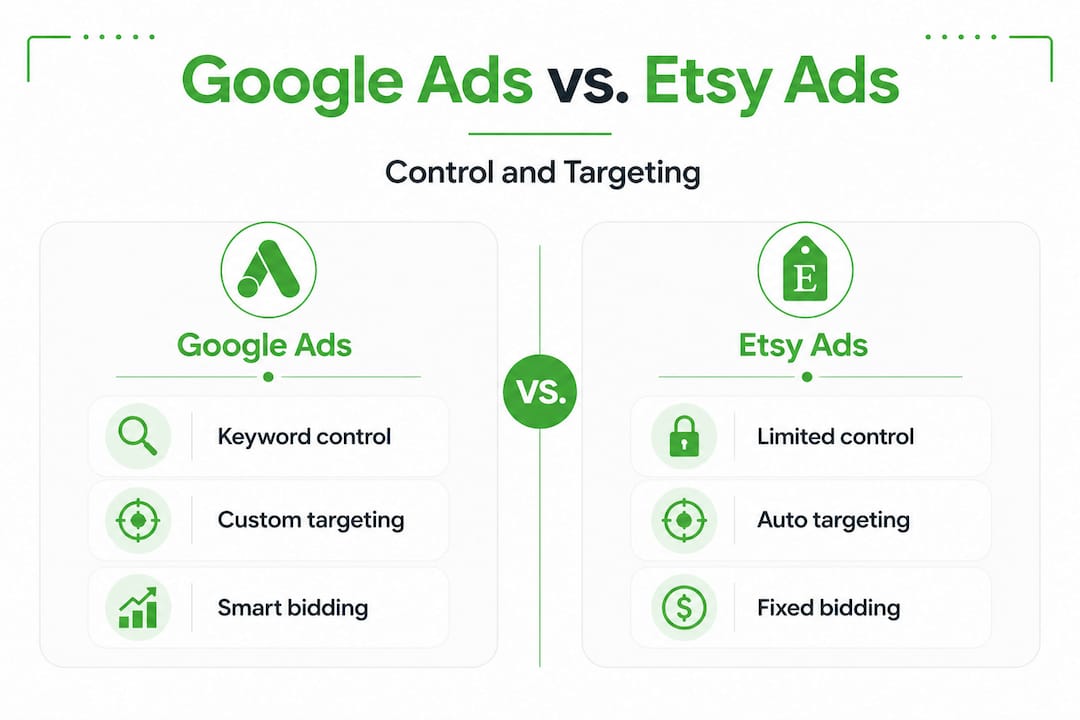
Understanding how Etsy Ads are placed helps clarify why the auction model inside Etsy limits your control. You are competing against other sellers with no ability to adjust bids by keyword, time of day, or device.
Google Ads wins for handmade sellers in several specific situations:
- When your products have clear, searchable attributes (material, style, occasion, personalization)
- When you sell in a niche with low Etsy search volume but strong Google demand
- When you want to retarget past visitors or build lookalike audiences
- When you need granular data to justify ad spend and scale what works
"Buyers searching Google for handmade products are often further along in the purchase decision. They know what they want. Meeting them there with a well-optimized ad is one of the highest-leverage moves a handmade seller can make."
Pro Tip: Before running Google Ads, review your top-selling Etsy listings and note the exact phrases buyers use in reviews and questions. These become your seed keywords for Google campaigns.
Learning the full picture of Google Ads for Etsy sellers is the foundation. From there, optimization is what separates sellers who break even from those who scale.
How optimizing campaigns empowers handmade sellers
Once you understand the strengths of Google Ads, it is critical to know what optimizing campaigns actually involves and why these technical changes matter.

The first layer of optimization is your product feed. Google Merchant Center feeds built from Etsy listings need specific attention to titles, descriptions, and images. A well-structured title follows this format: brand + product type + key attributes. For example, "ArtisanCo Handmade Ceramic Coffee Mug, 12oz, Speckled Blue, Wheel-Thrown" performs far better than "Blue Mug." Google's algorithm reads these titles to match your listing to relevant searches. Weak titles mean poor match rates and wasted impressions.
Images are equally important. Google Shopping relies heavily on visual appeal to drive clicks. Use clean, high-resolution photos on white or neutral backgrounds. Lifestyle images can work in some placements, but product-only shots typically perform better in Shopping results. Sellers who upgraded their images alongside title optimization saw a 33% CTR increase in documented case studies.
Beyond the feed, three technical settings make a significant difference in attribution accuracy:
- ads_redirect: This parameter routes traffic through a tracking URL before landing on your Etsy listing. It allows Google Ads to record the click and associate it with downstream conversions.
- Enhanced conversions: This feature sends hashed customer data (like email addresses) back to Google when a purchase occurs, improving conversion matching across devices and browsers.
- Consent Mode: Required for compliance in many regions, this setting adjusts how tags behave based on user consent, and Google uses modeled data to fill in attribution gaps.
While Etsy's AI shopping partnership with Google improves general visibility, it does not give you the granular control you need. Sellers who rely on this integration alone still face the 12 to 15% offsite ad fee and muddled attribution. Manual feed optimization bypasses these limitations.
The pitfalls of skipping proper setup are real. Without ads_redirect, you cannot connect clicks to sales. Without enhanced conversions, you lose attribution on a significant share of purchases that happen across multiple sessions or devices. Without Consent Mode, your data quality degrades over time, especially for European buyers.
To track conversions from Google Ads accurately, you need all three of these elements working together. Sellers who skip even one of them often report that Google Ads "doesn't work," when the real problem is invisible data.
Pro Tip: When you upload Etsy purchase data directly into Google Ads as offline conversions, you give the algorithm actual sales signals rather than proxy metrics like clicks or page views. This dramatically improves Smart Bidding performance over time.
"Feed optimization is not a one-time task. Revisit your titles, descriptions, and images every quarter, especially when you add new products or shift your product focus seasonally."
Winning strategies: Campaign structures and smart bidding for handmade
To make technical optimization tangible, let's break down how to structure your campaigns and power up results with smart bidding.
Campaign structure is where most handmade sellers make their first major mistake. They lump all products into one campaign, set a daily budget, and hope for the best. The problem is that a $40 handmade candle and a $12 soap bar have very different margin profiles, conversion rates, and search behaviors. Grouping them together means the algorithm cannot optimize effectively for either.
Here is a framework for structuring campaigns by strategy type:
| Campaign type | Best use case | Bidding approach | Notes | |---|---|---|---| | Shopping (Standard) | Proven best-sellers | Manual CPC or Target CPA | Start here for control | | Performance Max | Broad reach, new audiences | Smart Bidding with audience signals | Use after 30+ conversions | | Search | Brand terms, high-intent queries | Manual or Target CPA | Protect your brand name | | Remarketing Display | Past visitors | Target CPA | Low cost, high intent |
Campaign structures for DTC ecommerce emphasize segmenting by high-margin items and using Smart Bidding only after you have sufficient conversion data, specifically 30 or more conversions in a 30-day window.
Here is a step-by-step approach to building your structure:
- Identify your top five listings by organic Etsy conversion rate. These are your proven sellers and should anchor your first campaigns.
- Create one Shopping campaign per product category. For example, separate jewelry from home decor. This keeps bidding and budget decisions clean.
- Add negative keywords from the start. Block terms like "wholesale," "cheap," "free," and any irrelevant product types. This prevents low-intent traffic from consuming your budget.
- Start with manual CPC bidding. Set bids based on your target cost per acquisition. For a $50 product with a 30% margin, your maximum CPA is $15.
- Monitor for 30 days. Once you hit 30 conversions, switch to Target ROAS Smart Bidding. Feed it a realistic ROAS target based on your actual data, not wishful thinking.
- Layer in Performance Max after your Shopping campaigns are stable. Use your best customer emails and website visitor lists as audience signals to guide the algorithm.
The advanced Etsy ad data you collect during this phase becomes invaluable for refining bids and identifying which listings deserve more budget.
The results from structured campaigns are well-documented. One wholesale jewelry brand went from $18,000 to $80,000 per month in revenue with a 791% ROAS by segmenting campaigns by product line and applying Target ROAS bidding only after building a solid conversion history. A single-person Etsy shop doubled sales by simply organizing listings into structured feeds rather than relying on Etsy's default export.
Etsy SEO for ads also plays a role here. The same keyword research that improves your Etsy listing rank can inform your Google Ads keyword targeting, creating a reinforcing loop between organic and paid visibility.
How to track results and attribute sales accurately
All these strategies only make sense if you can measure what works. Let's clarify how to accurately attribute sales and track results for your handmade ads.
Accurate tracking starts with a clean setup. Follow these steps in order:
- Connect your Etsy feed to Google Merchant Center. Verify your domain (or use a tracking subdomain) and submit your product feed. Check for disapprovals weekly.
- Implement the ads_redirect parameter in your feed for all active listings. This routes clicks through a Google-readable URL before landing on Etsy.
- Enable enhanced conversions in your Google Ads account. This requires adding a tag or using Google Tag Manager to capture purchase confirmation signals.
- Activate Consent Mode v2 if you sell to buyers in the EU or UK. This ensures your tags comply with privacy requirements while Google fills attribution gaps with modeled data.
- Set your attribution model to data-driven. This model uses machine learning to assign credit across all touchpoints in the conversion path, rather than giving all credit to the last click.
Data-driven attribution matters especially for handmade sellers because buyers often research over multiple sessions before purchasing. A buyer might click your Shopping ad on Monday, return via organic search on Wednesday, and complete the purchase on Friday. Last-click attribution would give zero credit to your Google Ad. Data-driven attribution distributes credit appropriately.
Key metrics to monitor weekly:
- ROAS (Return on Ad Spend): Revenue divided by ad spend. Target 300% or higher for most handmade products.
- Conversion rate: Purchases divided by clicks. Industry benchmarks vary, but 1 to 3% is typical for Shopping ads.
- Cost per conversion: Total spend divided by number of purchases. Compare this to your product margin.
- Impression share: How often your ads show versus how often they were eligible to show. Low impression share with a good ROAS signals room to scale budget.
- Search term report: Review this weekly to add negative keywords and discover new positive keyword opportunities.
Common mistakes that break tracking include using the wrong conversion action (tracking "add to cart" instead of "purchase"), failing to verify the Merchant Center domain, and not testing the ads_redirect URL before launching campaigns.
Pro Tip: Use the Etsy attribution window guide to align your Google Ads attribution window with Etsy's own reporting window. Mismatched windows are a common source of confusion when comparing data across platforms.
Tracking conversions from Google to Etsy requires ongoing maintenance, not just a one-time setup. Review your conversion data monthly and reconcile it against your Etsy order history to catch any gaps.
A realistic perspective: What most Etsy sellers miss about Google Ads
With practical systems in place, there is a deeper layer most sellers should consider. Here is our hard-earned perspective.
The most common piece of advice you will find online is "just set up Google Shopping and let it run." This advice consistently disappoints sellers because it skips the part that actually matters: attribution. Sellers who set up campaigns without proper conversion tracking are essentially flying blind. They see clicks and spend, but they cannot connect those clicks to actual Etsy orders. Without that connection, the algorithm has nothing to learn from, and the campaigns stagnate or waste budget.
Attribution should be your North Star, not traffic volume or click-through rate. A campaign with 50 clicks and 10 purchases is worth far more than one with 500 clicks and 2 purchases. Yet many sellers optimize for the wrong signal because it is the one they can see most easily.
Small shops can absolutely outcompete larger budgets. The advantage handmade sellers have is specificity. A mass-produced goods retailer cannot bid on "hand-thrown wheel pottery mug with speckled glaze" because they do not sell that product. You do. Highly specific, long-tail keywords often have lower cost-per-click and higher conversion rates precisely because the buyer knows exactly what they want.
After seeing the results from hundreds of sellers, one pattern stands out clearly: the sellers who succeed with Google Ads treat it as a data collection exercise first and a sales channel second. They start with small budgets, gather conversion data, and let that data guide every subsequent decision. Sellers who start by spending heavily and hoping for immediate returns almost always end up frustrated.
The proven Etsy ad strategies that work consistently share one trait: they are built on real conversion data, not assumptions. If you take one thing from this article, let it be this: set up your tracking before you spend a single dollar on ads.
Take the next step: Make handmade ads work harder for you
Optimized Google Ads campaigns deserve equally optimized tracking. Without accurate attribution, even the best campaign structure will leave you guessing about what is actually driving your Etsy sales.
IndiePixel is built specifically for Etsy sellers who want to close the gap between their ad spend and their actual sales data. The platform connects your Google Ads campaigns to your Etsy order history, giving you clear visibility into which clicks led to purchases. You can also use the Etsy cart count checker to validate product demand before committing ad budget to a new listing. For sellers ready to move from guessing to knowing, IndiePixel's Etsy ad tracking provides the attribution layer your campaigns need to perform at their best.
Frequently asked questions
Do I need a Google Merchant Center account to advertise Etsy listings?
Yes, you need a Google Merchant Center account to set up optimized feeds from your Etsy listings for Shopping Ads and to enable proper conversion tracking.
Can I see which Google Ads sales actually resulted in Etsy orders?
With enhanced conversions and data-driven attribution properly configured, you can match Google clicks to Etsy purchases with significantly greater accuracy than relying on last-click or Etsy's own reporting alone.
How is optimizing Google Ads different for handmade vs. mass-produced products?
Handmade products require custom keyword strategies, detailed feed titles with material and technique attributes, and campaign segmentation to avoid competing on generic terms where mass-produced goods dominate and budgets are far larger.
Should I use Smart Bidding or manual bidding for handmade product campaigns?
Start with manual CPC or Target CPA to build a conversion history, then transition to Target ROAS Smart Bidding once you have at least 30 conversions in a 30-day window for reliable algorithm performance.