Validate cart performance and boost Etsy ad ROI in 2026
Learn how Etsy sellers can use a cart checker methodology and Shop Stats to validate listings, reduce wasted ad spend, and improve ROI before running paid ads.

Many Etsy sellers assume they need a dedicated software tool to check cart performance before running paid ads. That assumption leads to wasted budget and frustrating results. The truth is that no established cart checker tool exists specifically for Etsy sellers. Instead, a cart checker is a methodology: a structured way to audit your listing data before committing ad spend. Using built-in Etsy Shop Stats, you can identify which listings have genuine demand and which ones will drain your budget. This guide walks you through exactly how to do that, step by step.
Table of Contents
- What is a cart checker in Etsy ecommerce?
- How to validate cart performance before running Etsy ads
- Benchmarks and metrics: What constitutes a high-performing cart?
- Practical actions: Optimize listings for better cart performance and ROI
- A fresh perspective: Why organic validation beats abandonment recovery for Etsy sellers
- Connect your shop to IndiePixel: Advanced cart tracking and ad optimization
- Frequently asked questions
Key Takeaways
| Point | Details | | --- | --- | | Cart checker is a process | Successful Etsy sellers use Shop Stats and in-carts to validate listings before advertising. | | Organic metrics matter most | Listings with 2-3%+ organic conversion are most likely to deliver profitable ad results. | | Optimize before ad spend | Fix cart abandonment and listing issues—like photos and shipping clarity—before investing in paid ads. | | Benchmarks guide scaling | Compare your conversion and ROAS against industry averages to decide which listings deserve ad dollars. | | No special tool required | Cart checking can be done using Etsy’s built-in Stats—no external software or plugin needed. |
What is a cart checker in Etsy ecommerce?
The phrase "cart checker" gets tossed around in Etsy seller communities, and it creates real confusion. Sellers often search for a plugin or dashboard that shows them how many shoppers added their item to a cart. That tool does not exist for Etsy. Etsy does not expose real-time add-to-cart data to sellers.
What sellers actually need is a methodology for reading in-cart proxies: indirect signals that tell you whether shoppers are genuinely interested in buying. Think of it as reading the behavioral evidence rather than a direct number.
Here is what that evidence includes:
- In-carts count: Etsy shows this on individual listing pages within your dashboard. It reflects how many active shoppers currently have your item saved in their cart.
- Favorites: A high favorite count relative to views suggests strong interest, even if it does not always convert.
- Views-to-orders ratio: This is your organic conversion rate, the clearest signal of listing performance.
- Revenue per listing: Listings generating consistent organic revenue are safer bets for ad spend.
You can access the Etsy Cart Count Checker framework to structure how you review these signals systematically.
Key insight: A cart checker is not a tool you install. It is a pre-ad audit process that uses the data Etsy already gives you. Skipping this step means advertising listings that have not proven themselves organically.
The purpose of this methodology is straightforward: avoid spending money to drive traffic to listings that shoppers are not buying. Paid ads amplify what already works. They do not fix what does not. By reviewing your Shop Stats features before launching a campaign, you make sure your ad budget is working with proven demand rather than against uncertainty.
This is the foundation. Once you understand what a cart checker actually is, the next step is running the audit itself.
How to validate cart performance before running Etsy ads
Validating cart performance does not require a third-party tool. Your Etsy Shop Stats panel holds everything you need. Here is a step-by-step process for auditing your listings before you run ads.
- Open Shop Stats and go to Listings: Navigate to your Etsy seller dashboard, click Shop Manager, then Stats. Filter by the last 30 to 90 days for meaningful data.
- Record views, favorites, and orders for each listing: Export this data or manually note it in a spreadsheet. You need at least these three columns.
- Calculate your organic conversion rate: Divide orders by views and multiply by 100. A listing with 200 views and 6 orders has a 3% conversion rate.
- Check the in-carts number per listing: Go to each individual listing page in your dashboard. The in-carts figure appears when active shoppers have that item saved.
- Prioritize listings for ads: Use the data to rank listings. Only listings with consistent conversion should enter your ad campaigns.
Here is a sample comparison of how this looks across three listings:
| Listing | Views | Favorites | Orders | Conversion rate | In-carts | Ad-ready? | |---|---|---|---|---|---|---| | Ceramic mug | 420 | 38 | 14 | 3.3% | 7 | Yes | | Linen tote bag | 310 | 12 | 4 | 1.3% | 2 | No | | Enamel pin set | 580 | 64 | 19 | 3.3% | 11 | Yes |
Listings with under 2% organic conversion rarely improve with paid traffic. You are paying to expose a weakness, not fix it.
For a more structured approach to choosing which listings to promote, the listing selection framework breaks this decision into clear criteria. Sellers who use Shop Stats consistently report better ad targeting decisions because they are working with real data rather than guesses.
According to analytics guides for Etsy sellers, prioritizing listings over 2-3% organic conversion rate before running ads significantly improves return on ad spend.
Pro Tip: Do not advertise a listing until it has generated at least a 2% organic conversion rate. That threshold confirms shoppers find the listing relevant and are willing to buy, which means paid traffic will convert at a profitable rate.
From here, understanding what "good" looks like in benchmarks will sharpen your decisions further.
Benchmarks and metrics: What constitutes a high-performing cart?
Knowing your numbers is only useful when you know what those numbers mean. Here are the benchmarks that define cart performance on Etsy and in ecommerce broadly.
Conversion rate: Etsy conversion averages 2-3% across the platform. A listing at or above 3% is performing well. Below 1.5% is a signal to pause and investigate.
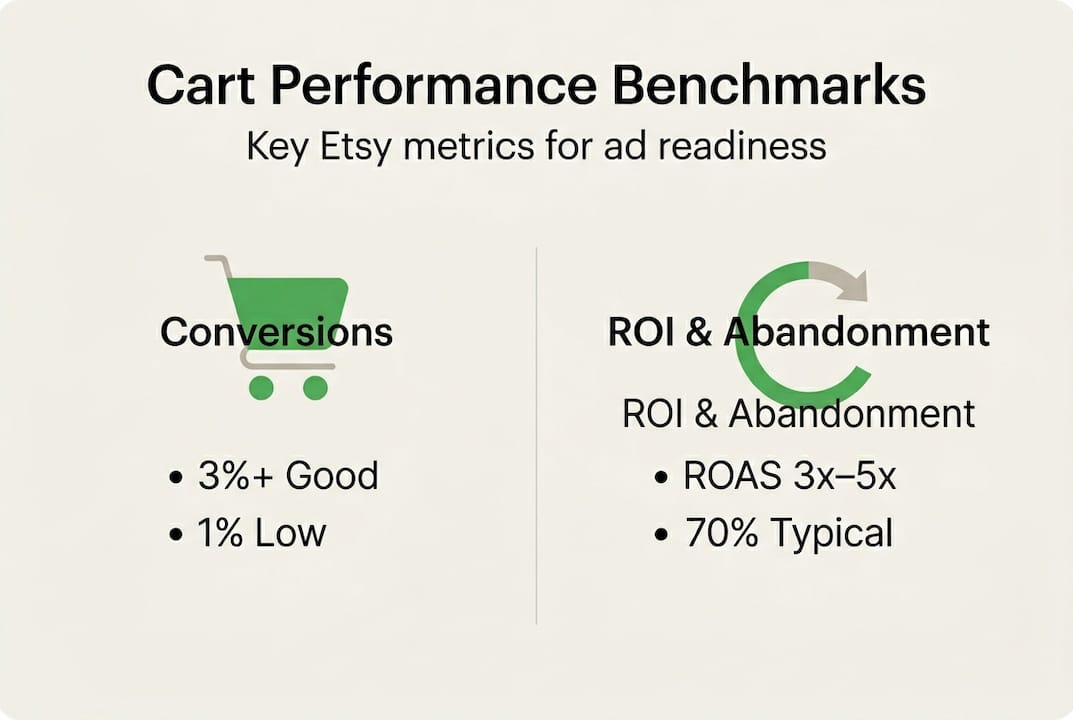
Cart abandonment: Approximately 70% cart abandonment is typical across ecommerce. This means most shoppers who add an item never complete the purchase. Knowing this, your job before running ads is to remove every friction point that might cause a shopper to leave.
Return on ad spend (ROAS): A ROAS of 3x to 5x is considered profitable for Etsy ads. Below 2x, your ad costs are eroding margin. Use the Etsy conversion benchmarks guide to calibrate your expectations by niche and price point.
Here is a quick reference table for Etsy ad performance benchmarks:
| Metric | Below average | Average | High-performing | |---|---|---|---| | Organic conversion rate | Below 1.5% | 2-3% | 3%+ | | Cart abandonment rate | Below 60% | ~70% | N/A (lower is better) | | ROAS | Below 2x | 3x | 5x+ | | Favorites-to-orders ratio | Below 10% | 15-20% | 25%+ |
For a listing to qualify as ad-ready, it should meet most of these criteria:
- Organic conversion rate at or above 2%
- At least 3 to 5 completed organic sales
- In-carts count greater than zero (indicating active buyer interest)
- Clear, high-quality photos with no known shipping complaints
- A price point that supports a 3x ROAS after ad cost
Tracking these essential Etsy KPIs regularly gives you a dynamic view of which listings are building momentum and which are stalling. It is also worth noting that price comparison behavior among online shoppers affects abandonment rates, which is why pricing clarity and value communication matter alongside listing quality.
Once you know your benchmarks, the next step is fixing what is pulling your numbers down.
Practical actions: Optimize listings for better cart performance and ROI
Benchmarks tell you where you stand. These actions move you forward. Before you invest in paid ads, address the friction points that hurt cart performance.
Fix your photos first. Product images are the single biggest driver of click-through and conversion on Etsy. Listings with blurry, poorly lit, or confusing photos fail before the shopper reads the description. Use multiple angles, include a scale reference, and show the product in use.

Be transparent about shipping. Unexpected shipping costs are one of the top reasons for cart abandonment. State your shipping cost and estimated delivery time clearly in the listing description and the first photo if possible. Shoppers who feel surprised by fees leave. To enhance ROI by fixing cart issues, shipping clarity is non-negotiable.
Optimize for mobile. Mobile traffic is 70% of Etsy visits. That means your listing photos, titles, and descriptions must communicate value instantly on a small screen. Long, dense paragraphs in descriptions hurt mobile readability. Front-load the most important details.
Here are additional techniques to reduce abandonment and improve conversion before ad spend:
- Add specific size, material, and care details to eliminate hesitation
- Use keywords buyers actually search, not just creative product names
- Include social proof: mention reviews or total sales in your description
- Offer free shipping where margin allows, or bundle shipping into pricing
- Respond to any open questions or complaints in reviews before advertising
Pro Tip: Build your ad campaigns around listings that already have 3 to 5 organic sales. Those sales confirm real demand, provide Etsy's algorithm with conversion signals, and give you a baseline ROAS to measure against. New listings with zero sales are a high-risk bet with paid traffic.
For a broader view of how listing optimization connects to ad performance, the Etsy Ads Strategy Playbook provides a 30-day framework for connecting listing optimization tips to actual campaign results.
A fresh perspective: Why organic validation beats abandonment recovery for Etsy sellers
Most ecommerce advice focuses on recovering abandoned carts: retargeting ads, abandoned cart emails, discount codes. That playbook makes sense for standalone Shopify stores. For Etsy sellers, it is largely inapplicable. Etsy does not give you shopper email addresses or direct remarketing access. You cannot send an abandoned cart email to a visitor who left your listing.
This is why organic validation is a more powerful strategy for Etsy sellers than abandonment recovery. When a listing consistently converts before ads, it signals that the photos, price, description, and shipping terms are working. Ads simply put that proven listing in front of more of the right people.
Chasing abandonment recovery tactics on Etsy wastes time on a problem you cannot directly solve. Investing that energy into in-carts prioritization insights and pre-spend validation solves the problem you can control. Understanding ad auction mechanics reinforces this point: Etsy rewards listings with strong conversion history in its ad auction. Organic validation does not just help your ROI. It helps your ad placement, too.
Connect your shop to IndiePixel: Advanced cart tracking and ad optimization
You now have a clear methodology for validating cart performance before running Etsy ads. The next step is automating and scaling that process.
IndiePixel's Etsy Cart Checker brings together in-cart signals, conversion data, and ad attribution into one unified dashboard. Instead of manually pulling Shop Stats and building spreadsheets, you get a structured view of which listings are ready for ads and which need work. IndiePixel also connects your Etsy sales data to Facebook, TikTok, and Google Ads through the Etsy ad tracking tools available on the platform, giving you accurate attribution so you know exactly which campaigns are driving revenue. Stop guessing. Start tracking.
Frequently asked questions
Is there an official cart checker tool for Etsy sellers?
No. The cart checker is a methodology using Etsy Shop Stats and in-cart proxy data. There is no standalone software or Etsy-native tool that tracks real-time add-to-cart events for sellers.
What is a good conversion rate for Etsy listings before running ads?
Aim for at least 2-3% organic conversion per listing before spending on ads. Etsy conversion averages 2-3% across the platform, so listings at this threshold or above are your strongest candidates for paid promotion.
How can I improve cart performance on Etsy?
Focus on photo quality, shipping transparency, and mobile readability. Fixing cart issues first, specifically photos and shipping clarity, is consistently linked to higher conversion rates and better ad ROI.
Why shouldn't I advertise new listings before organic sales?
Listings with at least 3-5 organic sales provide proven conversion benchmarks and give Etsy's algorithm useful signals. Getting 3-5 organic sales before advertising reduces wasted spend and improves your ad placement competitiveness.
Does cart abandonment impact Etsy ad ROI?
Yes. With abandonment rates averaging 70% across ecommerce, unresolved friction in your listing will reduce the effectiveness of any ad campaign. Fix cart issues before you invest in paid traffic.
Recommended
- Etsy Cart Count Checker: Use In-Carts Data to Prioritize Listings
- Etsy Conversion Rate Guide: How to Improve Listing Performance Before Scaling Ads
- Articles & Guides | IndiePixel
- Etsy Ads Strategy: A Practical 30-Day Playbook
- Track eCommerce Metrics in 2026: Boost Growth by 30%
- Playable Ads In Ecommerce - playablemaker.com Playable Ads In Ecommerce